
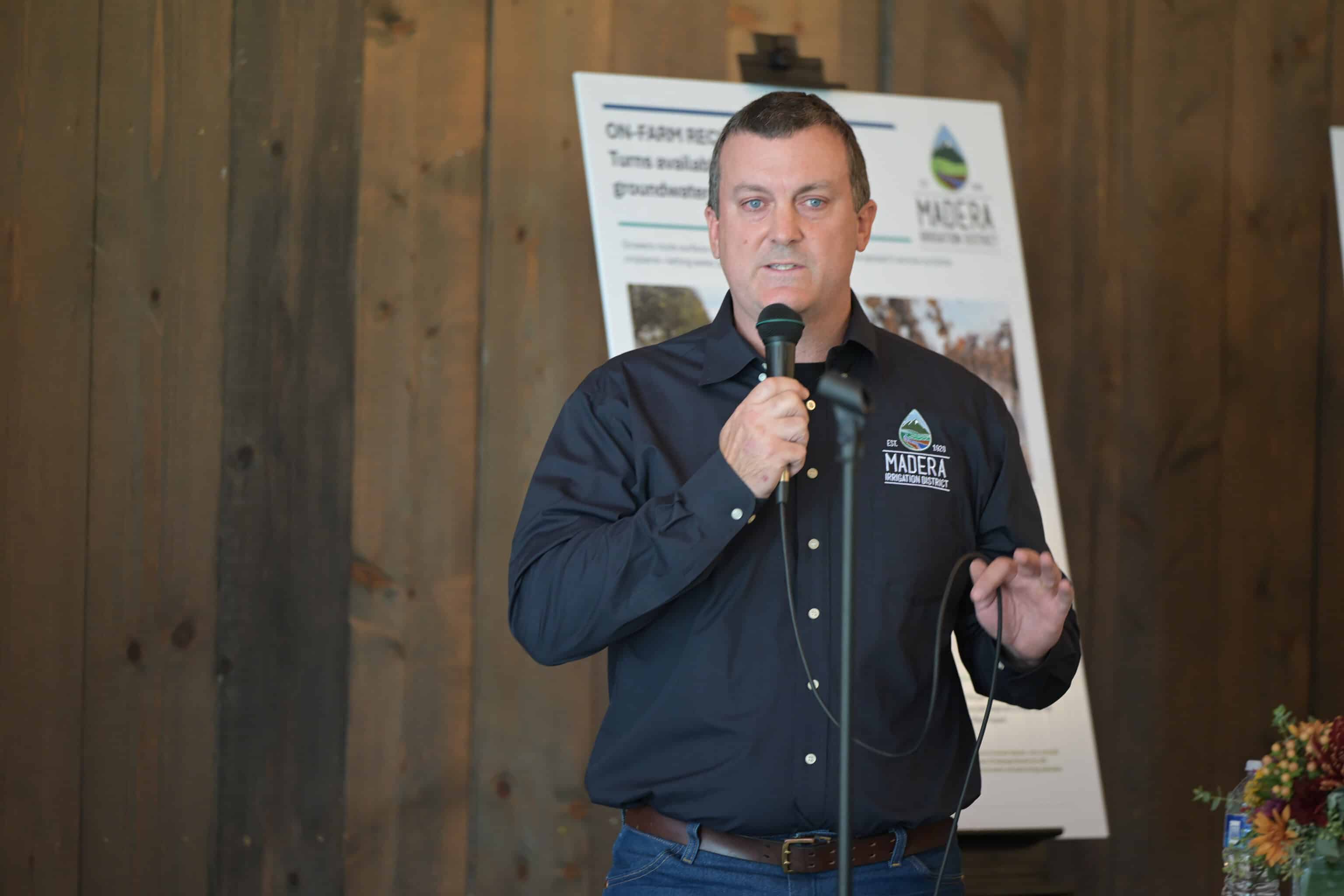
On the heels of finally getting debt free, the Madera Irrigation District hosted a Growers Luncheon to address some of the District’s accomplishments, and let growers know what to expect in the near future.
“We have an opportunity this year, hopefully, to have a wet year,” said MID General Manager Tom Greci. “We have the basins. We hope it all comes together. We’ve had El Niños with zero water. 2023 was fantastic, and brought in almost 400 acre feet of water. Now, we have additional capacity. If we can get the growers to step up and store water when we get a wet year, and use our basins, we could break 400 acre feet.”
“We have an El Niño coming. We have paid off these bonds. It’s a great time to regroup,” said MID Board of Directors member Dave Loquaci. “By being able to become debt-free, and have the growers use the water, and manage it, the value of the land has gone up significantly. The growers are in a water district that is financially sound and has water. The MID keeps the water priced at an affordable rate. The growers are probably in the best district they can be in.”
Pipe system
The MID manages more than 150 miles of pipeline, which laid down, end-to-end, will end up in the Bay Area. Most of those pipes were installed in the 1940s and it’s way past its life.
“It’s gone through a reactive maintenance approach over the last few years,” Greci said. “Until recently, it was fix it when it breaks and patch it. We’ve been aggressively replacing pipelines. In 2019, we wanted to understand better what our problem was. We did a capital improvement program to look at all of our infrastructure. To maintenance all of those pipes that were way past its life, we needed to start replacing them. We took advantage of funding opportunities, and replaced more than 36,000 feet of pipe. That was all done in house without any contractors. The pipes are triple-walled, good-quality pipe that is going to outlast all of us in this room. That’s been a great accomplishment.
“In addition to that, we’ve added automation alarms in the systems. They let us know when pipes dry up or have too much water on our phones. Those are all coming together nicely and are helping the reliability of our system.”
Recharge basins
Recently, the MID announced a new recharge basin in the Fairmead community. That was one of the main focuses the MID had, and they built a 60-acre recharge basin.
“It creates a huge opportunity for them,” Greci said. “There’s been projects offered up for years out there. MID came out, and found an opportunity with a parcel that was for sale, and we acquired it. Within two years, it was ready to go. That facility is ready to go, and we’re proud of it. Those basins are going to be great.
“We’ve added five basin projects. These are properties that we acquired, removed the crop and put in a recharge facility. Most of these are 40-60 acres. Those were all constructed in house. They did the work in a short period of time. It was a huge cost savings by doing it internally. I would put our staff up against any contractor. The quality of work they do is fantastic.
“We have about 215 acres of additional recharge capacity. These are priceless, especially on years like we had. We had a very short window of rain season. We want to save as much as we can as quick as possible. We opened up the reservoirs to take up huge gulps of water, and spread it, and it’s water we would have lost to the ocean. By having these in our system, we have a great opportunity take advantage of the wet years or short season windows. We have our existing facilities. We are managing more than 1,000 acres of recharge spread all through the District. It’s pretty amazing the amount that we now have.
City of Madera partnership
While handicaps may have taken a rise at the Madera Municipal Golf Course, Greci and the MID will take credit for that by filling in the water hazards at the golf course, in conjunction with the City of Madera.
“We filled up the water hazards at the Madera Municipal Golf Course. We ran pipeline, and connected to it, and it has water in it,” Greci said. “The handicaps have gone up. But, it helps the aesthetics of the golf course when you put water in it.
“The City has been very aggressive about putting water into basins. We just finished a new development by Tozer that has a large basin. Those are huge benefits, and its thousands of acre feet that wouldn’t have recharged. The City relies, 100 percent, on groundwater for their supply. By recharging that water really helps the City.”
Groundwater recharge
Madera has been the pioneers of groundwater recharge which is, basically, to over-saturate the ground while crops are dormant.
“You put water in the ground, and basically just saturate it,” Greci said. “Gravity pulls it down into the aquifer. By just having the growers simply spread it and overirrigate, it’s not taken up by the plants, they’re dormant. It just saturates the ground. So instead of having dedicated recharge, we’re really focused on recharge with deep reservoirs, we just spread it across the farm. There’s been some farm that actually submerge the plants. That’s all it is, just saturating the ground, just like the rain would.
“If you get this early on and really soak the ground, it’ll stay there. And so, when it comes to irrigation, your crop will pick it up, and you don’t have to irrigate.”
Growers anticipate a wet water season with the El Niño effect coming in, and Greci educated farmers how they can take advantage of it.
“It’s 50 percent chance of being wet,” he said. “We are prepared to take water, and put it into the ground. We looked at this about 10 years ago, and we were the pioneers in groundwater recharge. If El Niño comes about, and we have extra water, there’s no additional cost to put infrastructure in to do groundwater recharge. You basically turn on your pumps and spread water. That can take a lot of water, and put it into the ground at no extra cost. However, the water is not free. The MID will give water at a reduced rate to create order in a system.”
“Back 10 years ago, growers didn’t use the water,” Loquaci said. “Since then, we’ve used every drop of water we could get. The growers have done that. In the big wet years, the growers spread the water early. We’ll price it as low as we can. If the growers don’t put the water on the field, it’s not going to happen. My personal goal, if we have a wet year, is to have 450 acre feet. I think it can be done if it lasts the length of the season.”
Madera Ranch project
The MID purchased 11,000 acres of land in 2005 with the thought of making the land a water bank. However, because of environmental issues, it wasn’t feasible. Now, the MID had this huge chunk of land, and didn’t know what to do with it.
“After years of looking at what the best options were for that property, we determined it would be ideal for the district to preserve it for what it is. We leveraged the environmental restrictions to a benefit. To keep it what it is was what we felt was the best option,” Greci said. “We worked with Trust for Public Lands, which is a non-profit organization that helps preserve open space for environmental and public resource benefits.
“Ultimately, they entered into an option agreement, which was executed, and purchased by them,” Greci added. “That property is part of the process that has extensive deed restrictions. That means they can’t do anything to that property. They can’t develop it or pump ground water. It’s going to be what it is. It will be preserved, and hopefully, open to the public as public resource. It was a win-win for everyone, especially for the District that it helped with the debt from the property. We aren’t property managers, we’re water managers.”
MID is debt-free
With the sale of the Madera Ranch, it allowed the MID to tackle some of the bonds and debt it had accumulated throughout the years.
When Greci started with MID about 10 years ago, the MID was $100 million in debt and bonds with a budget of about 12million-15 million. The growers were getting charged through a special assessment, but the MID looked into re-funding the bonds, which were at a high interest level.
“There were favorable interest additions within the market,” Greci said. “Unfortunately, we were coming off a severe drought where we had zero allocation in 2014 and 2015. We decided to go to San Francisco, and tell them they needed to increase our bond rating. We had zero revenue two years in a row. It was one of the most stressful interviews.
“The engineer they had knew California water and knew Madera Irrigation District,” Greci said. “What was supposed to be a half-hour interview turned into six hours. We got our bond rating improved. We re-funded the bonds and got creative on how we did that. Ultimately, we shorted those way down, and paid them off way earlier.”
The 2015 bond was eliminated this year, and was shown on this year’s tax bill. Paying off the bonds early allowed the MID to save $25.6 million from the 2015 bill and $18.4 million from the 2016 bond, and all of those savings trickle down to the the growers.
“We were going to be paying until 2040, and it’s done, including 2038 on Madera Ranch,” Greci said. “Along the way, we replenished our reserves. We didn’t have reserves, and we had big debt. Now, we don’t have to seek funding for projects. We get them done in house. Farmers should see that on their bills. We’ve invested the money, and we are getting millions of dollars in interest. It’s a huge swing on our budget that is going to happen this year. We’re really excited to achieve that. It was 10-plus years in the making to pay it off that early.
“So by having reduced expenses, we can collect less, which means our water rates can come down. The more affordable we can make water to our growers, the better. Lower-priced water can mean they will use more. We can also continue to invest in the district by replacing the pipelines, buying new properties and continuing to grow our recharge capacities.”
“All of these accomplishments took years to do,” Loquaci said. “And, we did it with the staff we had. We didn’t hire a bunch of consultants. The last major consultant firm was in 2019 when we did our assessment of our pipeline because we didn’t have the time. All of this was done with the office workers, who aren’t a complete staff.”