
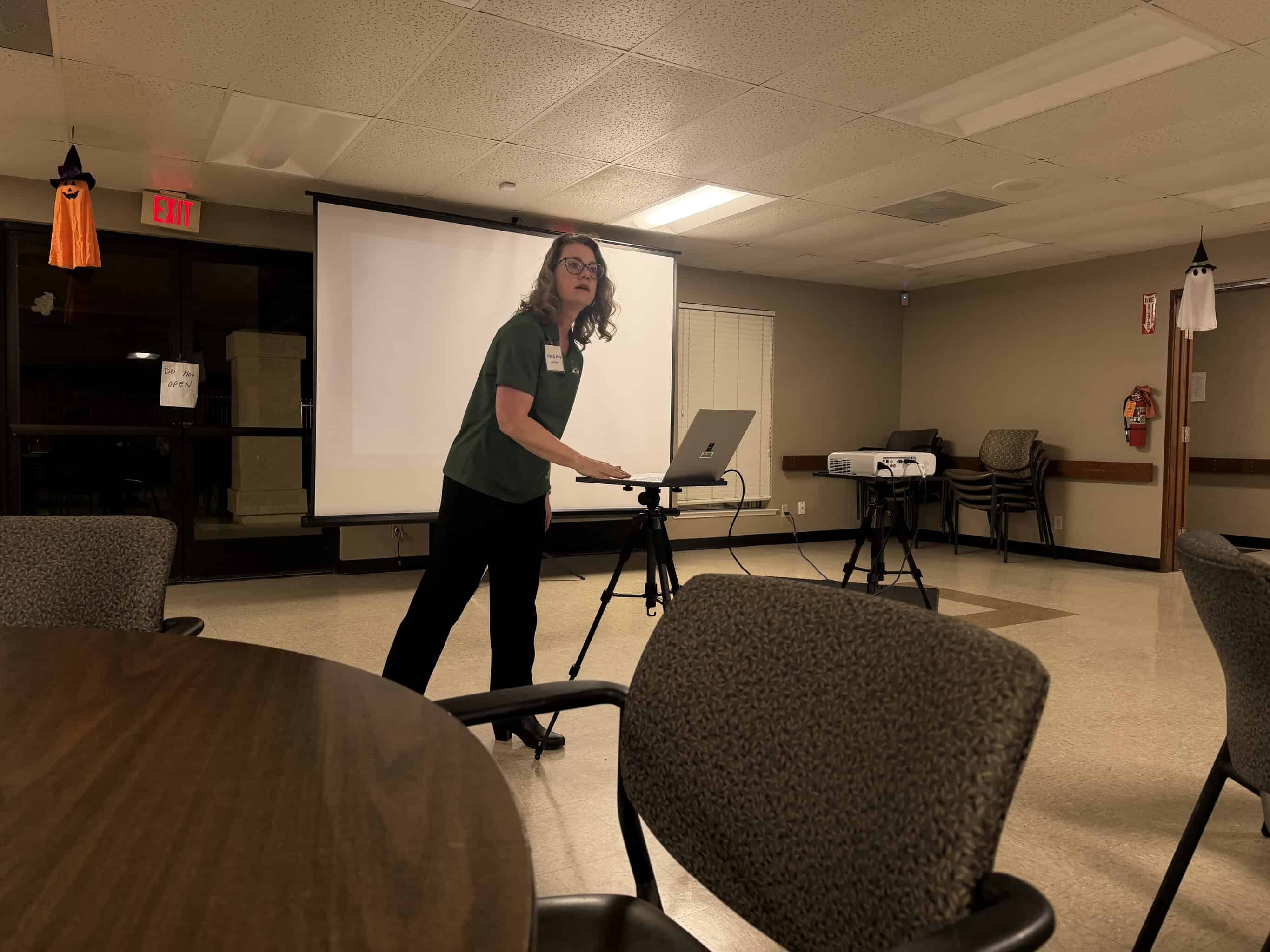
This week’s Citizens Academy, hosted by the City of Madera, met at the Frank Bergon Senior Center, where Director of Financial Services, Michael Lima, and Director of Human Resources, Wendy Silva, gave presentations on their respective departments.
“You’re hearing some pretty impressive things that the city government is doing for the citizens of Madera,” Lima said. “But to be perfectly blunt, all those other department directors and what they do, they can’t do anything without money and people. So tonight is the most important class of the entire session that you’re gonna go to.”
The city has budgeted $242.1 million for the current fiscal year while working to fill specialized positions, manage employee benefits and maintain essential city services.
Lima, who has worked in government finance for about 35 years and has been with Madera for three-and-a-half years, said the city has maintained a balanced budget for eight consecutive years. Before that, the city had six consecutive deficit budgets.
“We’re very proud that the city of Madera for the last eight years has had a balanced budget,” Lima said. “Expenses match the revenue.”
The city’s $242.1 million budget includes $105.3 million for capital projects, $62.5 million for operating expenses, $41.6 million for personnel costs and $32.7 million for debt payments.
Public Works accounts for the largest share of city spending at $103.5 million, followed by Engineering at approximately $63 million and Police at $23.3 million.
The city’s general fund, which supports services such as police and fire protection, totals $47.4 million. Police account for 36.2 percent of general fund spending, while fire services account for 11.2 percent.
Sales tax is the city’s largest single source of general fund revenue, with Madera receiving one percent of its 8.25 percent sales tax rate.
The presentation also covered upcoming transit changes. Following a study approved by the City Council on August 5, the City plans to eliminate two of its four fixed routes, and reconfigure the remaining two to increase service frequency from once every hour to once every 30 minutes.
Other proposed changes include introducing micro-transit, extending service hours, using Uber and Lyft after normal service hours, and creating a shuttle connection to Fresno’s transit system. Lima said the city’s target launch date for the new system is July 1, 2028.
Silva then presented an overview of Human Resources, and its role in city operations. Her four-person team handles recruitment, employee onboarding, benefits, labor relations, workers’ compensation, liability claims, property damage recovery and emergency preparedness.
The department implemented an online recruitment system in 2024 and is working to reduce paper records through a scanning project.
“I am working really hard in our department not to have any more paper,” Silva said. “I really like online systems where everything’s captured. And so that’s what we’re working for.”
Police positions account for a significant portion of recruitment activity, while the city also faces hiring challenges for specialized positions in water quality, water distribution and wastewater operations. Silva emphasized that certain positions require state certifications to operate city infrastructure.
“We do need people in the trades who are interested in getting a state certification, because while we are not setting that requirement, we are legally obligated by the state to have these certified operators to run our systems,” Silva said. “In order to dig in the road on that water line, you have to have a water distribution operator from the state of California. In order to work independently at our wastewater plant, you have to have at least a grade two.”
New employees also participate in a full-day orientation designed to introduce them to city departments and services.
Risk management includes evaluating liability claims involving issues such as vehicle damage caused by potholes, falls on sidewalks and damage caused by falling tree limbs. Silva explained that the city participates in a risk-sharing arrangement with other municipalities, with Madera paying the first $100,000 of a liability claim before costs move into a shared insurance pool.
The department may also seek reimbursement when an individual damages city property.
In one example, damage to a traffic signal controller resulted in approximately $29,000 in damages. Silva said the City may seek reimbursement through insurance payments, restitution through the District Attorney’s Office or private payment arrangements to cover repair costs.