
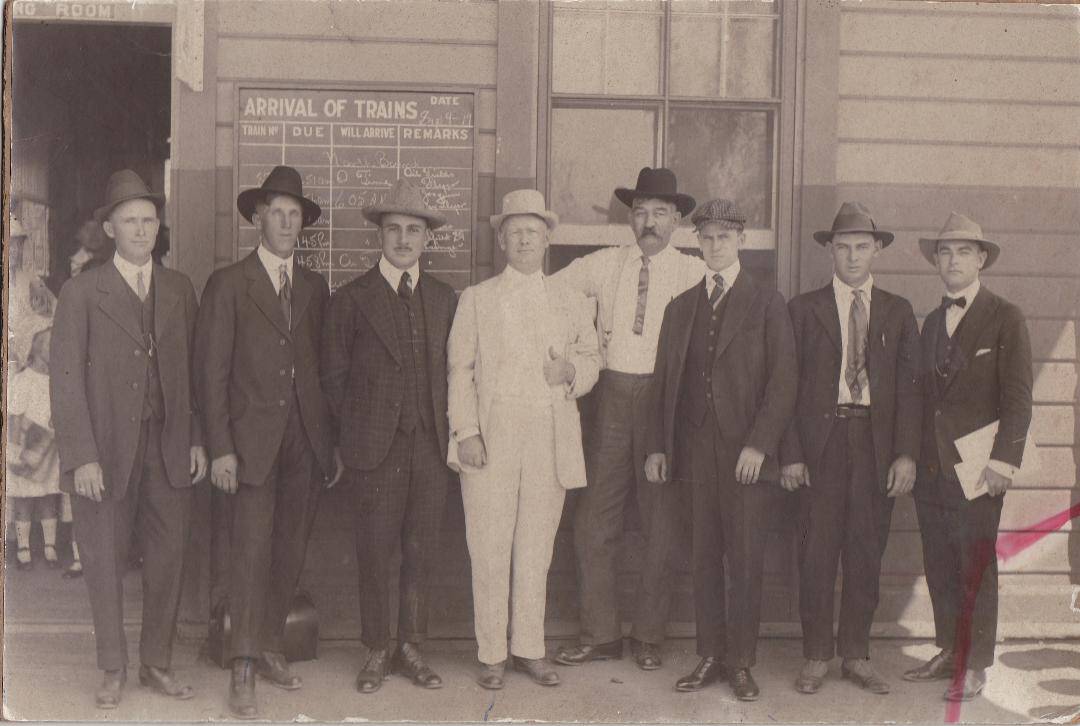
On April 6, 1917, the United States entered World War I, and reaction across the nation was quick in coming. Overnight the Germania Life Insurance Building in St. Paul became the Guardian Building. School boards across the land banned the teaching of the German language. Sauerkraut was renamed “liberty cabbage,” and in Madera the name of Munich School was changed to Dixieland.
In the meantime, Maderans of all persuasions supported the entry of the United States into the worldwide conflagration. Within three days after the declaration of war, Maderans made preparations to do their duty by forming a para-military unit called the Home Guard.
When the United States enacted conscription, every male between the ages of 18 and 30 was required to register with the county clerk. It then became the sheriff’s job to make sure they did. Each prospective soldier was given a number, and a national lottery determined who would go and when.
The honor of being the first Maderan to register for the draft fell to William Robert Kimery, who appeared at the county clerk’s office as soon as the doors opened on the appointed day. The first Maderan who actually joined the military during World War I was Ralph Hosler, who signed up with the Ambulance Corps. Three days later, Bernard J. Kelly, a clerk at Rosenthal-Kutner’s, joined the U.S. Medical Corps.
Meanwhile, not everyone in Madera had the same patriotic outlook during World War I as Kimery, Hosler, or Kelly. The section foreman on the Southern Pacific, claimed that he was over the age limit and did not have to register or join. His youthful appearance aroused suspicion among those who knew him, and City Marshal, John Barnett, paid him a visit on orders from Sheriff Lewis. The Marshal had a plan to use domestic discord in the man’s household to carry out his duty.
It just so happened that the railroad man’s wife had left him for someone else several months prior, but upon coming to her senses had returned home. Apparently the husband wasn’t one to let bygones be bygones, and he let it be known that he was looking for the man who had stolen his wife’s affections. Armed with this knowledge, Barnett visited the railroad worker at his home.
Marshal Barnett led the section boss to believe that he had located the much-wanted home wrecker, and in order to get a better description of him, he asked for his age. When the draft dodger gave that information, Barnett asked him for his own age, which he also freely supplied, being preoccupied as he was with his domestic problems. The man blurted out that he was 27, and Barnett informed him that he was under arrest for refusing to register for the draft. The suspect was then transported to the county jail to await the arrival of federal authorities.
By contrast, 89 young Maderans from every ethnic group and socio-economic class willingly submitted to the draft, but before they could put on a uniform, they had to pass a physical. These were performed in the Madera County Courthouse by Doctor Dow H. Ransom, Doctor Allen of Raymond, and Doctor L. St. John Hely.
The actual examination took place in the basement of the courthouse after a roll call upstairs in the courtroom. At nine o’clock in the morning the first 20 men were led downstairs where they disrobed for the physicians. Each examination took approximately 30 minutes. The men were made to jump up and down and to give an exhibition of their best broad jumps. Then they had to hop around the room on one foot and then the other as rapidly as possible. They were required to stoop over, twist their bodies and go through a number of other exercises and all of this without a thread of clothing. At the end of that first day, 54 Maderans were judged to be fit for military service, and when it came time for the boys to march off to war, the town pulled out the stops.
Three thousand people gathered on Sept. 18, 1917, to say goodbye to Madera’s first contingent of young men who were being sent to fight in World War I. The boys all wore red badges and were on the receiving end of a huge burst of patriotic pride in Courthouse Park.
Madera’s official sendoff included a barbecue in the park in which 2,800 pounds of meat and barrels of beans were consumed. A special matinee was given at the opera house and was free to all who wore the distinctive red badges. The swimming pool opened for free, and a street dance was held.
Madera’s official sentiments regarding its participation in the war came from Superior Court Judge, William Conley, who gave an address to the crowd in the park.
Thus Madera said its good-byes to some of its finest young men. Many more would follow them throughout the remainder of 1917 and most of 1918, and some would never return. None, however would ever be forgotten.