
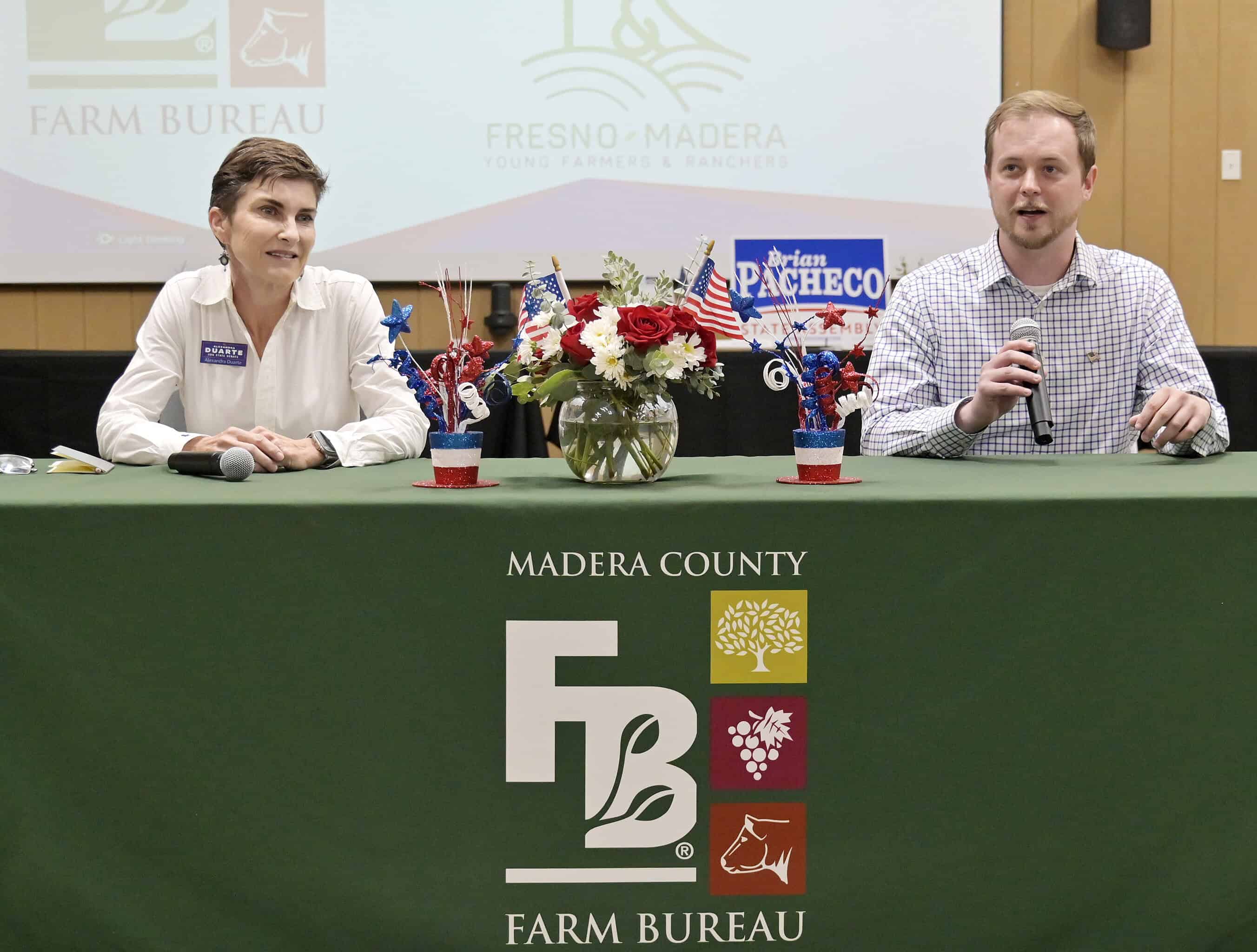
The Madera County Farm Bureau held a 2026 Candidate Forum in the Will Gill Pavilion.
Wednesday’s event was sponsored by the Farm Bureau, the Madera County Cattlemen’s Association, and the Fresno-Madera Young Farmers & Ranchers.
Participating in the forum were candidates who are on the ballot for the November election. Among them were candidates for Congress, State Senate, State Assembly, Madera County Supervisor, and Chowchilla mayor.
The moderator of the event was Christina Beckstead, Executive Director of Madera County Farm Bureau. For each candidate, she gave an opportunity to give an introduction for two minutes, to answer some prepared questions, giving them two minutes for responses, and to give a closing statement of two minutes. Rebuttals were allowed once for each question for one minute.
“Rule number one,” she said, “we will all be respectful tonight.”
The focus of the forum was mainly concerns of the farmers, the agriculture industry, and other issues of the California Central Valley.
The first participants on the agenda were congressional candidates Michael Masuda (D) running for District 5, and Kevin Lincoln (R) running for District 13. Lincoln was not present.
Michael Masuda gave his introduction, stating that he grew up on the northern end of this district in Amador County in Golden Country, a town of 200 people. He moved there in 1999 with his parents and two brothers.
“My parents really gave back to our communities,” he said. “And that is something that I’ve taken with me throughout my life.”
“We need folks that are willing to bring people together and talk about the issues in an honest way. and find compromise, find that common ground that we share,” he said. “And I think that’s something that we are interested in Congress and something that I’ve been leading with in this campaign.”
The first question asked of Masuda was about the problem of labor and innovation, and the challenges with federal immigration and agricultural labor policy.
What changes would you support to federal immigration and agricultural labor policy to address the needs of both agricultural employers and farm workers?
“We are seeing folks that are absolutely terrified in communities all across the state, all across the country, and that has a direct impact on our growers,” he said. “When there are so many other things that are unpredictable when it comes to farming, a reliable workforce should not be one of those things.
“I believe that we can have smart immigration reform, one that serves both people who want to come here, and American citizens; that serves our farmers, and makes sure that it’s fair and a clear process in which to come here. I think we do need serious reforms to make sure that people can get a work permit. We know that there are people that have been here for decades, that are here undocumented. Let’s give those folks a work permit because many of them have already been working hard and maybe some of you know those folks.”
What should federal farm policy do to better address the needs of specialty crop producers particularly regarding research, prop insurance, disaster assistance, market access, and regulatory compliance?
Masuda admitted he was not an expert in agricultural policy. He intends to learn more about it, and the direct impact it has on the community.
“My background is electrical engineering, defense, foreign policy, but I’m very eager to learn a little bit more and come and talk with folks about the issues of the farming community,” he said.
What specific federal actions would you support to increase the amount and reliability of water available to San Joaquin Valley agriculture, including storage, conveyance, operations of the CDP, and groundwater research?
Masuda stated that it is necessary to plan for the future of water, not for five years from now, but 30 years from now, 40 years from now.
“First thing, we need to look at the infrastructure that we have right now, and address leaks in that system, making sure we are optimizing water that is actually coming down the mountains, coming from these other parts of California, and making sure it gets delivered where it needs to go,” he said. He stated that there were not good numbers on how much water we’re actually losing in the system.
“We need to invest in research because as We have seen that our climate in California is changing.
What changes, if any, would you support in federal trade and agricultural policy to address differences in production standards while maintaining access to affordable food and export markets for American agriculture?
“It starts with making sure that the quality of any type of food and agricultural products that comes into the United States is at comparable levels to what we produce here, that we are not allowing low-quality state, low-quality beef to flood U.S. markets and undercut U.S. ranchers, that we can trust that whatever we are eating is actually safe.
“I want to make sure that we can also export the things that we produce overseas. Our producers are getting hammered now because of the tariffs and the retaliatory tariffs, the trade wars that have been triggered, because of policies coming out of this administration and policies that my opponent has supported. “
In closing, Masuda stated that he is running in order to serve. He will be listening to the needs of the people. “To make sure that we are moving this country in a direction in which farmers don’t have to continuously fear bankruptcy, where we can make sure that we have a new generation of young farmers.
The next participants were candidates running for State Senate District 4, Jaron Brandon (D), and Alexandra Duarte (R).
Jaron Brandon is 34 years old, and was born and raised in Columbia, where he has been a County Supervisor for six years, representing Columbia and Jamestown. He became interested in public service while he was in college, and served as an intern for members of both parties.
When he returned home, he realized his community had a lot of challenges. There were drug problems, homelessness, road problems, underpaid deputies, and old fire equipment.
“There were a lot of issues,” he said. “I ran as a Democrat in a two-to-one Republican community that elected me against an incumbent by 19 percent. I’m familiar with being able to bridge the gap that we have so often in our politics right now between the left and the right, because I don’t think we’ve particularly been served in our rural areas by either party very well.
Alexandra Duarte is a farmer and a mom. She has been farming since 1995, working with Duarte Nursery.
“I’m running for state senate because I’m tired of watching everything get more expensive,” she said. “From our groceries to our gas and our insurance to water and power. Everything is getting more expensive for the working families here in California. And as a mom, watching California become a place that our kids can’t afford to live. That breaks my heart.”
The same questions were asked of both State Senate District 4 candidates.
What specific state investments or policy changes would you support regarding water storage, conveyance, groundwater recharge? or other water supply projects that could benefit agricultural regions such as Madera County?
Duarte: “We all know here in this room that California does not have a water problem. It has the longest, tallest watershed in the world. What we have is a Sacramento problem. There is plenty of water for everybody. And my job is to build the relationships and make people understand you use water to grow food. And that water affects the cost of the groceries for the people everywhere in this state. The water is directly related to the cost of living, but specifically to the cost of their groceries and the ability for their children to move into homes.
Brandon: “When we are sending somebody to Sacramento, we are sending them to be a messenger, whether they’re a Republican or Democrat, we’re talking about tens to hundreds of millions of dollars of investment. It’s not just give to the commercial and residences, but we’re also wanting to make sure that we can keep farms and ranches going. We need a problem solver within. we have to make sure that we can actually get it to the areas that right now are really primarily on groundwater. We’re going to have to make sure that we have the storage capacity up and down the state.
If elected, at the end of your term, what measurable results should Madera County farmers and ranchers be able to point to and say that you personally helped accomplish?
Brandon: “We talked about water, and that is one of my top priorities. It has to be, particularly for the valley, and then fire insurance. We’re talking Madera farmers, also the ranches, though a lot of the district for District 4 really is, it’s up the hill and foothill areas like where I live. So, two top priorities. One, the fair plan is destroying our communities. It is not something to be fixed, it is something to be replaced. We have to make sure that risk reduction and rate reduction go hand in hand. And so I would want to see an alternative that replaces the fair plan, potentially a public backbone, and investments in the state in reducing that fire risk, particularly on the private lands, not just the federal lands management. The second bit is you don’t need me to be an expert in your groundwater tables here, your basins, and I’m not going to try to be. I’m not an elected that thinks the state leaders are ahead of the local leaders.
“My job is to go and get as much of that funded as possible. Conveyance projects, storage projects, making sure you actually have clear recharge credits for the upcoming drought, and making sure that whatever California does pass, you know that I’m in there advocating for you.”
Duarte: “When I’m a state senator and I can come back here and talk to you. And we have abundant water very quickly because I understand that it’s a state security issue. we can build more houses so that water that we have in California and it’s restricted to us by our state government is really going to affect what we can do here in the valley and that is what I want to be able to come here and talk about.”