
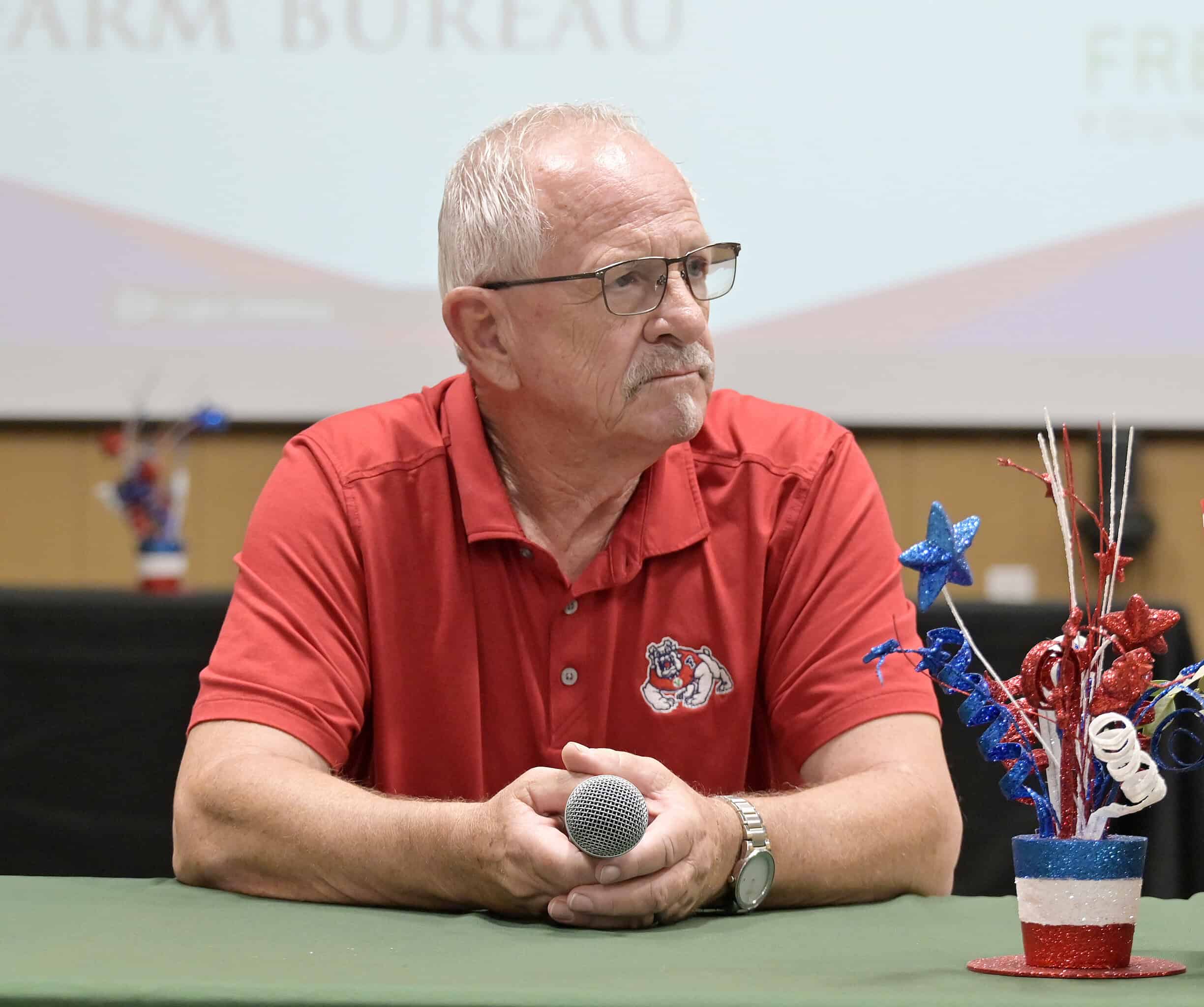
The Madera County Farm Bureau held a 2026 Candidate Forum in the Will Gill Pavilion.
The event on October 7 was sponsored by the Farm Bureau, the Madera County Cattlemen’s Association, and the Fresno-Madera Young Farmers & Ranchers.
Participating in the forum were candidates who are on the ballot for the November election. Among them were candidates for Congress, State Senate, State Assembly, Madera County Supervisor, and Chowchilla mayor.
The focus of the forum was mainly concerns of the farmers, the agriculture industry, and other issues of the California Central Valley.
State Senate District 14
Darin DuPont was born and raised in Merced County. His wife is also born and raised in Merced County. They have a daughter, who will turn two in November. He is a city council member, and an attorney with his own law practice in Merced.
He has extensive knowledge in water and environmental law, and a concentration in municipal law.
“There’s a special place in growing up in the Central Valley. The values you learn, the people you know, and they are here to protect you and advocate for you every step of the way,” he said. “That’s what I wanted to do. I wanted to come back home and not only represent people here as an attorney, but also advocate for them.”
At the age of 27, he realized his City Council was in dire straits. They had wrong priorities and weren’t supporting public safety. Their streets and roads were deteriorating, so he announced he was running for City Council.
In 2024, he won the City Council race and currently serves District 1 for Merced.
How should the state address the broader economic consequences for farm workers, ag businesses, local governments, schools, and rural communities when ag production declines, and what policies would you pursue to minimize those impacts?
DuPont: “They need to recognize that it’s actually happening. That’s first and foremost. I don’t think there’s a recognition from Sacramento that the economy and the business of being a farmer, being a rancher, being a dairyman, is not economically viable in California. Being a water attorney, I know there is no one on the Senate side or the Assembly side that is educated or practices in water. I’m the only candidate in the State of California that practices in water law. So those policies are very important to what we do as a state.”
What should California’s long-term strategy be for ensuring that farming and ranching remains economically viable in the state?
DuPont: “We’ve got to stop right now (with new policies). Because if we don’t stop now with more regulation and more policies that impact us economically in the farming community, then it’s going to get worse and worse. We have to start deregulating. We have to look at the policies that are currently in place ,and how we can make it better for the farming community.
“We talked about overtime laws. Overtime laws are the same thing. Colorado figured this out real quick, but California missed. Because Colorado not only increased the amount of hours, but they also gave tax credits. These are the type of real policies, real issues that we need to discuss and talk about and pass to start moving in a different direction than continue to regulate and put on more policies and more economic strain on our farmers and ranchers.”
If elected, at the end of your term, what manageable result should Madera County farmers and ranchers be able to point to and say that you personally have to accomplish?
DuPont: “One, being a water attorney, I’ll be highly focused on water. And it’s going to the policies like I discussed on legal issues and allowing for fair competition, fair execution, but it’s also discussing how does 48 percent unimpaired flows impact farms when we’re already handcuffing them on the Sigma side as well. Those are the type of policies that we need to change in California.
“Right now, we talk about groundwater recharge projects, but guess who’s funding groundwater recharge projects? Farmers and water districts. Going to Sacramento and saying, sure, let’s work on the environmental issues, but we need to fund it as well. We can’t rely on the farmers to always pay us out of environmental issues. And, I always think it’s funny when we talk about environmentalists versus farmers because farmers are the environmentalists.”
Chowchilla Mayor
Kelly Smith is running for re-election for Mayor of Chowchilla. In his introduction, he talked about the state of the city.
“The community doesn’t know the things that are going on in their own town,” he said. “They do not realize, sometimes the cost of doing business is you need new roads. New roads are about a $1 million a mile. I think we set aside a million dollars a year, and we have 62 miles of road in Chowchilla. So, by the time we get done in 62 years, we’ll be starting over, won’t we?
“Our citizens realized, and they passed measure N, so we have the funding and we are now fully staffed with our police department. We put in the license plate reader cameras that have solved crimes. Then all of a sudden, you see on the internet that people are spying on our citizens, and they don’t want these license plate readers. So it becomes an issue.”
How should you balance housing and economic development with preservation of agricultural land and avoidance of conflicts between urban residents and neighboring farming operations?
Smith: “Recently, we were annexing in about five acres that was farmland. And the owner of that ranch is asking to annex it into the city so we’re trying to control growth, and we’ve been very slow about it. We’re concentrating on educated growth, and some of our growth is mandated by the state. The rural housing that needs assessment are controlled by California. So, any land that we do annex in, it’s predetermined on what we can use it for. So, City Council will pick an area where we do our town map and our housing project, and we’ll say this is going to be residential high density, this is going to be low density, and this is going to be high density. And the reason that becomes important is right outside the city limits, we have two large almond orchards with water wells. If we’re to grow those areas, it’s a $1 million to put in the municipal well. So we have to be cognizant of the ag wells in the area.”
When considering new development, how should the city evaluate whether adequate long-term water supplies exist?
Smith: “Particularly given the groundwater challenges, we were so fortunate we could have built a park and named it after the Council, and everybody would have loved us. But if you don’t have water for that park, it doesn’t fill your need to build the park. We spent every penny of our code money on wells and water tanks We were able to put in three new wells and two water tanks. So, we understand the importance of water. I grew up out in the country, so I definitely understand water.”
Agriculture generates economic activity well beyond the farm. What opportunities do you see for Chowchilla to attract ag processing, manufacturing, equipment, technology, or other businesses that support ag and create local jobs?
Smith: “Come on down. We’re business friendly. Our industrial right now we’re at zero and we we don’t have any openings right now. We’re very business friendly. We actually thought of that when AutoZone came in. We were expecting that to happen really fast and it hasn’t. But the local business that we have, Valley Pipe and Steel, was going to leave the community if we didn’t find a home for them. So we were able to find a home for them, and it was actually a little more acreage than they wanted. But, they said, we’ll take it.”
What is one area where you believe the city of Chowchilla and Madera County’s ag community could work together more effectively?
Smith: “I think it would be just maintaining the relationships that we already have.
“We’re an ag community already. I can tell you, I wouldn’t even be here tonight if all my friends that live in the county couldn’t vote for me. The farming community is 80 percent farmers and dairymen that are supporting the city. We work hand-in-hand together, and it’s worked for 100 years. We just had our 100-year anniversary, and I see it working for 100 more. We have a very good working relationship with the farming community, and everybody on the Council wants to maintain that.”