
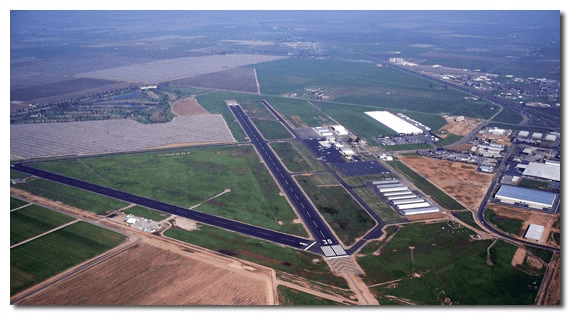
As the airplane came in from the south and reached the airport, it looked as if it was on its final approach, but it didn’t land. It continued its flight on past the runway. A crowd had assembled for this historic event, and now it seemed that the pilot was toying with the spectators.
At the north end of the flight pattern the Curtis Hell Diver SV2C made a 180 degree turn and headed back toward the airport. The casual onlooker would have been puzzled, but Lt. Bill Rogers knew precisely what was happening. Madera was being invaded. Its Municipal Airport was being taken over by the United States Navy.
World War II was far from over. Scores of Maderans were in uniform and many had made the supreme sacrifice in the defense of freedom. Now the city had been called upon to make a different kind of contribution. The Air Ferry Service of the United States Navy had established a series of 13 naval air stations, beginning in Petersburg, Virginia, to service aircraft which were bound for the Pacific theater of the war via the west coast of the United States. Madera was chosen because its airport could handle any plane the Navy flew and with just a few alterations, the location could be turned into a showcase for the Air Ferry Service.
City officials were of course receptive to the idea. At 2 p.m. on Aug. 3, 1944, they gathered to welcome the first military aircraft to the ‘’Madera Naval Air Station,” and to formally turn the airport over to Navy officials. Madera Mayor John Gordon officially led the local delegation which included W.S. Hillis, president of the Chamber of Commerce, and Craig Cunningham, secretary of the Chamber.
After he circled the airport three times, Lt. Max Wetters brought the SV2C in for a landing. He was met by a ground crew and escorted to the speaker’s rostrum where Mayor Gordon placed a huge horseshoe made of flowers around the airman’s shoulders. The large crowd of onlookers applauded their approval, and the official ceremony began.
Mayor Gordon initiated the rite by giving a brief resume of the negotiations that had taken place between the Civil Aeronautics Administration, the Navy, and the City of Madera. It was acknowledged that “the local field, while not yet fully equipped to take its place among the larger Ferry Command units, is rapidly meeting the requirements and will within a few weeks be able to handle as many as 100 planes a day.”
Gordon promised that “extensive improvements’’ would be forthcoming, including the erection of three buildings and the construction of a road from Highway 99 to the airport. Gordon asserted that “thousands of dollars will be spent putting the field in shape for the command.”
Lt. Rogers, commander of the Madera facility, represented the Navy in giving the official acceptance, and at the conclusion of the ceremony, he ordered the “hoisting of the national colors and the Navy flags.” At that point, with sailors saluting and the crowd at attention, the national anthem was played, giving the entire affair a definite patriotic flavor.
With the ceremonies over, the people left. Maderans returned to their homes while the sailors retired to their quarters in the Aragon Hotel. On that first day of official business, there were nine enlisted men and two officers, including Lieutenant Rogers, assigned to the Madera Station. These numbers were to swell to more than 30 before the Navy was through with Madera.
One of those later assigned to the Madera installation was Aviation Machinist Mate 2/C Lloyd Pelster. He remembers each morning the military contingent made its way from downtown Madera to its duty station at the airport. Much of the time that duty was routine. Incoming planes, most of which were fighter planes destined for Alameda Naval Air Station, were refueled and flight line maintenance performed. Occasionally the men were sent out to seal off the wreckage of a plane that did not make it to the field. At the end of the day, with the exception of those on watch, the sailors returned to their quarters in Madera.
Pelster recalls one of his favorite off-duty activities was the football games which took place between the Madera High School team and a military team from the airport. There was also time for socializing with the local ladies, as Pelster’s experience bears witness. He met, courted and married Gloria Ray Ahles, which accounts for his presence in Madera County for a long time.
Rogers, in the meantime, was equally taken up with opportunities in Madera. On August 15, 1944, he wrote to his family in Georgia, “We are finally in operation — ships landing here — both on (the) way (to) and from the fleet — we have a rather crude set up, but it is serving the purpose, until the new construction is completed…”
Concerning his new community, Rogers, commented, “I am enjoying my stay here fine — A lieutenant in this town has about the same privileges as a captain has around a big station. Wish you could see this country. There is something about it that gets under your skin, and I have given some thought to staying out here after the war….”
Indeed Rogers did remain in his new home. The Navy returned the airport to the city in July 1946, and by that time the lieutenant was firmly fixed in Madera. He quickly became a prominent businessman, forming the Rogers Materials Company on Pine Street. He invested in Madera real estate and became involved in housing construction. Rogers was an officer in the Western Concrete Pipe Association and in 1954 became the Madera County chairperson of the Goodwin Knight-for-Governor Committee. He was also a member of the Madera Rotary Club, the Madera County Planning Commission, and a director of the Madera County Chamber of Commerce.
Bill Rogers never forgot how he wound up in Madera. This little Valley town had become partners with the United States Navy. History records that thousands of planes were ferried through the Madera airport to be used to combat aggression abroad. In the process, a handful of individuals were introduced to life in the best part of the San Joaquin Valley and remained to make their contribution to its society. Madera received a good return on its investment.