
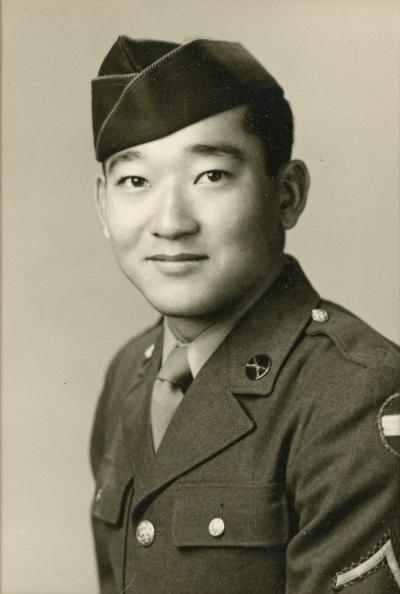
Scattered throughout Madera’s past are several quiet heroes — not heroes because of acts of bravery, but heroes because they engaged in silent acts of forgiveness repeated again and again, not in the context of a formal asking but rather freely given to the community. One of these was Sunny Nishimoto.
Recognized in Madera for his easy smile and gentle laughter, Nishimoto is also remembered for his selfless generosity and genuine concern for his community, especially its youth.
A group of Madera Method students recently researched Nishimoto’s life. They followed several sources that shed light on him, not the least of which were four videos of interviews that were done with him in 2005 and are preserved in the Japanese American Military History Collection. The recorded conversations cover nearly every aspect of Nishimoto’s life.
In his own mild manner, Sunny talks about his family, religion, and early farming experiences. He recalls how his parents founded the Bridge Store and several other businesses on North D Street. With tears in his eyes, he shares his feelings for the Barcrofts who took the Nishimotos under their protective wings when they faced the trauma of anti-Japanese hysteria during World War Two.
In his own inimitable way, Sunny talks about dealing with discrimination and the bombing of Pearl Harbor. He provided the students with a private look at the forced removal of his family, living conditions at the Fresno detention facility, and life in the Jerome concentration camp in Jerome, Arkansas.
Through these videos, the students listened to Sunny discuss being drafted, basic training, deployment, and his Army assignment in Japan. The young historians also heard Sunny discuss working with the community and “giving back” to Madera. They also learned what being an American meant to Sunny and what he thought about the legacy and future of America.
When the U.S. Government paid each survivor of the “Japanese relocation camps” $20,000 in reparation funds, Sunny gave his away to the Madera County Historical Society. Any time the Historical Society had an event that required food, Sunny, through the Bridge store, supplied the fare. He also contributed an indeterminate amount of cash to Madera schools.
Mr. Nishimoto was a civic leader, a successful businessman. a benefactor, and a philanthropist; “a gentleman and a good friend.” In 2005, the Madera Unified School District named a new school, Nishimoto Elementary School; to which Sunny and his family had donated a large sum of money toward playground equipment.
At Sunny’s passing, this writer said of him, “The attempt to adequately gauge the enormity of Madera’s loss with the passing of Sunny Nishimoto is an impossible task. His life of sacrifice without bitterness, his love of country, his love of community, his love of family; they all rise to a level that is beyond the ability of human expression. Like everyone else, I am numb.”
His “lack of bitterness” was cited and referred to the relocation of Sunny and his family during World War II. Sunny joined the United States Army and served in the First Cavalry Division, 442 Regimental Combat Team. He was attached to the Military Intelligence Service, where he decoded Japanese communications. At the end of the war, he was sent to Japan to serve as an interpreter during the occupation. Then, Sunny Nishimoto came home — free of bitterness.
He forgave. That made him a hero.