
The first Thanksgiving in 1621 lasted 3 days and according to the Farmers’ Almanac, the Pilgrims ate waterfowl, wild turkey, venison, shellfish, bass, cod, flint corn, and stewed pumpkin.
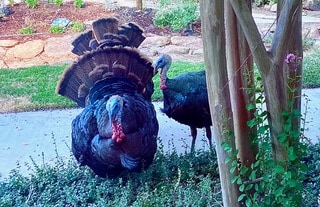
Today, traditional feasts this time of year have changed dramatically and often center on domestic turkeys served in a grand fashion. Domestic turkeys (bred for meat quality) have a reputation for being less than brilliant, docile and slow moving. However, the wild turkey has keen eyesight, agile and known to be quick of wing and foot.
Wild turkeys in California are primarily the Rio Grande subspecies introduced in the 1950s-1990s by the California Department of Fish and Wildlife after the native turkey Meleagris californica went extinct. Wild turkeys have expanded their range throughout California since the 1970s and their current population is estimated at roughly a quarter million birds. Many consider the turkey’s recovery one of the greatest conservation achievements of the 20th century. They now inhabit a variety of habitats and in Madera County, they are found in agricultural lands, woodlands particularly in the foothills and near water sources.
One of the biggest complaints gardeners have about wild turkey visitors is the mess they leave behind. They scratch around in the soil and among plants looking for food: insects, larvae, worms, seeds, soft fruits, nuts, plant matter and sometimes small reptiles. They roam in groups of six to thirty leaving their droppings behind which can get pretty messy. If you don’t want turkeys in your garden, don’t feed them and simply shoo them off.
Male turkeys can be a little noisy during the spring; they gobble, making a loud, rapid gurgling sound to announce their presence to females. Turkeys also make a clucking sound of one or more staccato notes to get attention. Sometimes a cluck is followed by a purr, a rolling sound indicating contentment.
In 1776, Benjamin Franklin proposed the wild turkey as a national symbol, considering the proud, adaptable turkey to be more respectable and noble than the bald eagle, which often steals food or feasts on carrion. In the end of course, the bald eagle won out.
Enjoy your Thanksgiving feast this year, remembering the wild turkey’s contribution to our history and national holiday!
More information about wild turkeys can be found at: https://ipm.ucanr.edu/home-and-landscape/wild-turkeys/.
SAVE THE DATE: Tuesday, December 8, from 9 a.m.-noon — December’s PLANT SALE and FREE one hour GARDEN TALK (10-11 a.m.) by a Master Gardener-Making Christmas Wreath Topiaries. Learn how to divide an ivy plant and make a FREE living Christmas wreath topiary. Sale and talk will be held at the Three Sisters Garden, located behind Madera Community College, 30277 Ave. 12, Madera.
Happy Gardening!