
As the teenaged historians walked silently down the trail that runs between the swaying Eucalyptus trees, the noise from the highway slowly began to retreat, and the well-manicured ranch that had been a refuge for George Washington Mordecai and his descendants rose up before them. The large ranch house, now more than 100 years old, sat securely on the space it had occupied when its predecessor had burned in the early 1900s. A scattering of smaller dwellings dotted the compound, the result of a growing family. The blacksmith shop, the bunkhouse, the tankhouse with its dairy room, the barn, the corral, they all merged into a composite landscape that gave the youngsters the feeling of having entered the real, old West.
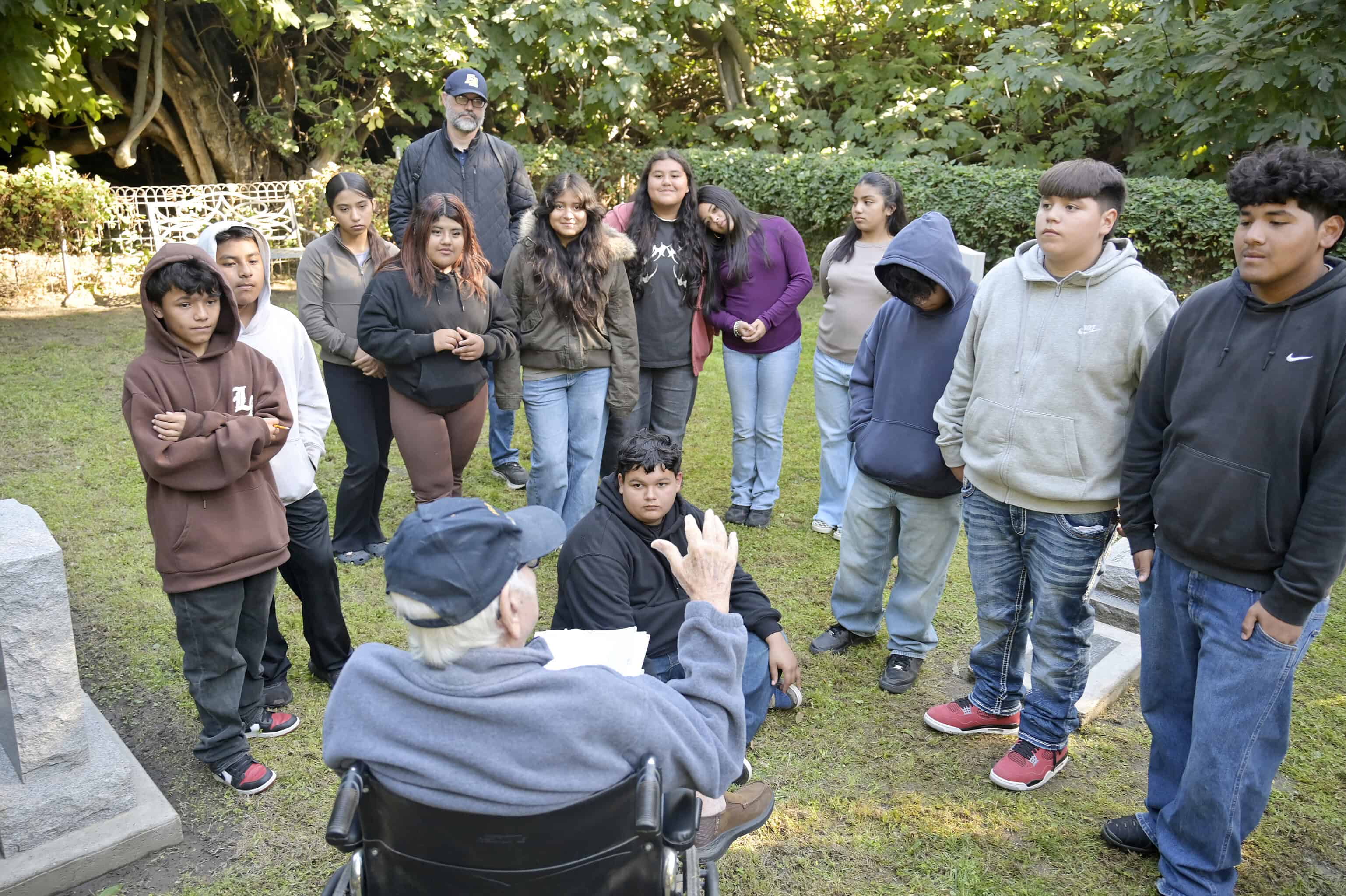
These 8th graders from Eastin-Arcola School took it all in. They had come to the Mordecai Ranch on November 5 with “stouter boots” to take their research into the life of G.W. Mordecai to a new level — to breathe the same air; to feel the grit of the ranch; and most of all, to visit the family in their final resting place on this earth.
As the young historians were led through the ranch, they realized they had come prepared. They had uncovered much about their subject, and that knowledge made their field study come alive.
Mordecai had been born in Virginia. His father was Augustus Mordecai, and mother was Rosina Young Mordecai. He had two older brothers, William and John, and one younger sister, Augusta.
He and his brothers fought for the South in the Civil War. After the War he moved to Raleigh, North Carolina where he had charge of one of his uncle’s plantations. In 1868 he came to California and bought the land that is now included in his present ranch, which was then a part of Fresno County, but is now part of Madera County.
He married Miss Louise Dixon, a native of Mississippi, and they became the parents of the following children: Richard Lawrence , George W. Jr., Louise, Brooke, and Ethelfleda.
The students have been highly motivated to research Mordecai’s life because he entered the first bill in the State Assembly to create Madera County out of the northern part of Fresno County, and they think that qualifies him to be recognized as the Father of Madera County.