
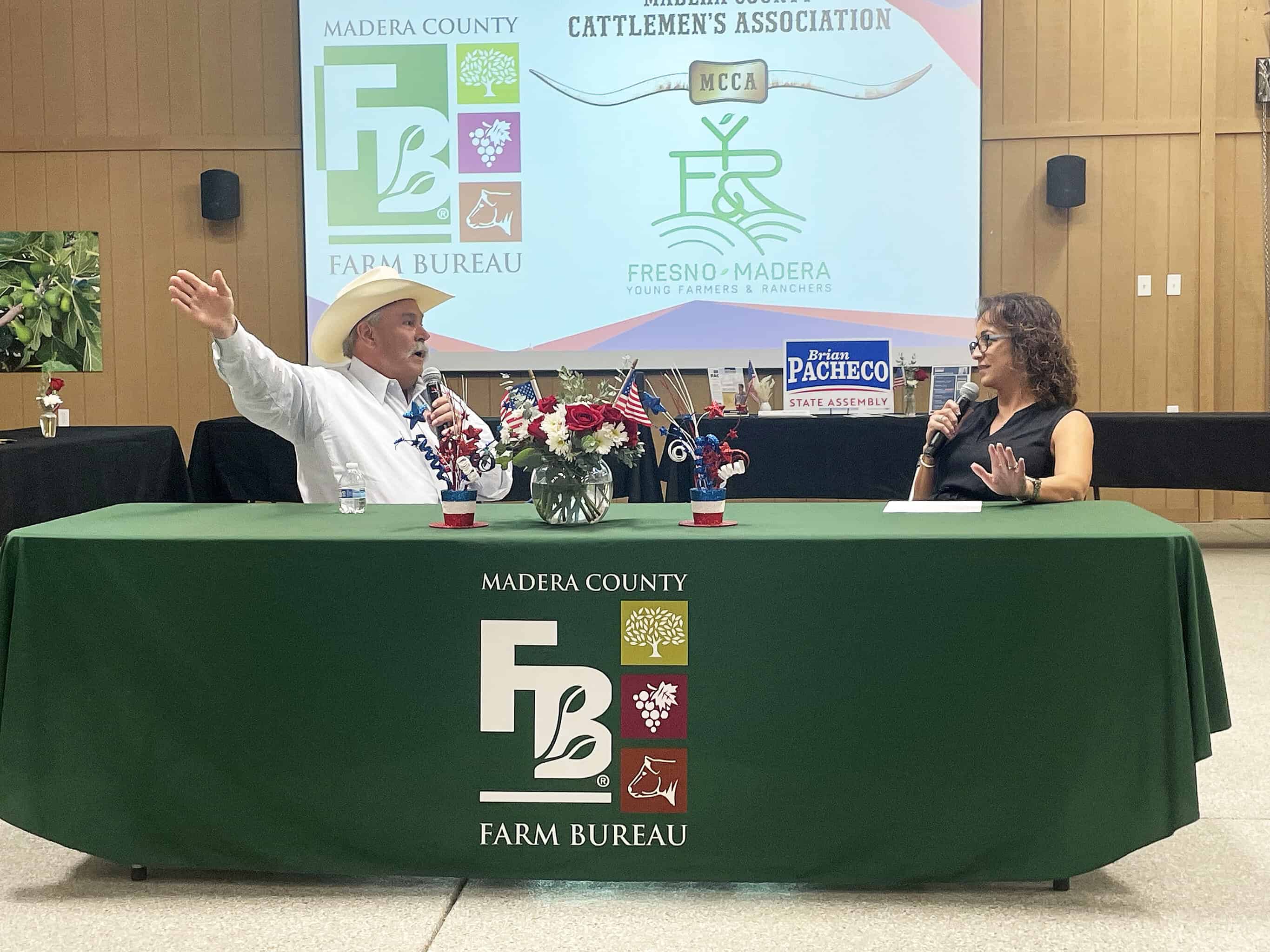
The Madera County Farm Bureau held a 2026 Candidate Forum in the Will Gill Pavilion.
The event, held October 7, was sponsored by the Farm Bureau, the Madera County Cattlemen’s Association, and the Fresno-Madera Young Farmers & Ranchers.
Participating in the forum were candidates who are on the ballot for the November election. Among them were candidates for Congress, State Senate, State Assembly, Madera County Supervisor, and Chowchilla mayor.
The moderator of the event was Christina Beckstead, Executive Director of Madera County Farm Bureau. For each candidate, she gave an opportunity to give an introduction for two minutes, to answer some prepared questions, giving them two minutes for responses, and to give a closing statement of two minutes. Rebuttals were allowed once for each question for one minute.
“Rule number one,” she said, “we will all be respectful tonight.”
The focus of the forum was mainly concerns of the farmers, the agriculture industry, and other issues of the California Central Valley.
State Assembly District 27
Mike Murphy comes from Merced County where he grew up. He became mayor of his hometown, and served for two terms. He served a total of nine years in local government.
“California is at a breaking point, and the ag industry in particular. This isn’t something I need to tell you, because you know. But I want you to hear it from me. We need to do better. This is the product of an imbalance in state legislature. We have one-party rule,” he said. “The incumbent’s not running. I have a strong record as mayor working with the local Farm Bureau. I want to see agriculture thrive in important conversations.”
Brian Pacheco is also running for Assembly District 27. He is the current Fresno County Supervisor, and has served for three consecutive terms (12 years)
“I was on my way to serve my fourth term when this opportunity arose, and I decided to take a leap of faith, and I’m going to run for the state legislature. I’m a fourth-generation dairyman and farmer, and there’s not one of us up there that’s a bona fide farmer,” he said. “My family has been here since the early 1800s, and I will continue to be here. My son, which is fifth generation, is now taking over the family farm, as my father has done for me. The valley is different than in San Francisco and Los Angeles and I’m there to provide that strong voice for our community.
California agricultural employers are now required to pay overtime after eight hours of the day or 40 hours of the week, despite our farming being highly seasonal and often dependent on weather and harvest windows. Do you believe current California labor laws provide enough flexibility for the seasonal nature of agriculture?
Murphy: “So, let me answer clearly, no. The current ag overtime laws do not benefit farmers or farm workers. We know that. We’ve got growers that can’t afford it.You have farm workers who have who have voiced not only to their employers, but also in testimony to the state legislature that they want change because they would like to work more and they like the old system better.”
Pacheco: “Again, as a fourth generation dairyman, we operate 24 hours a day, seven days a week, 365 days a year. In addition to our dairymen, we also have the farming operation. Nobody knows firsthand better than I what that entails and the overtime rules that are affecting us individually. It was a great intended, but we are not the city. We do not have a five day work week an eight hour work day or a 40 hour work week. That is not how we live. That is not how we survive, and that is especially true during the peak harvest time of the harvest This was intended to help the people, but it had unintended consequences.”
Would you support requiring state agencies to consider the cumulative economic impact of existing regulations before implementing additional requirements on agriculture?
Pacheco: “That’s where I can bring real-world-life experiences to the state legislation. As a dairyman, we have the most perishable products in the food chain, and we are the most regulated industry in all of that. We have the water board, we have the air board, we have the health department, we have the labor. Everything keeps coming in a cumulative effect, and it’s crushing. I have the mindset that there are no more new regulations unless you want to take one away or show how that is going to improve what we already have. They cannot keep passing more laws and more laws with the greatest intent possible, and yet it’s crushing us that are living and working this every day.
Murphy: “We have to take into account the cumulative cost. You can’t look at things in isolation. It’s death by a thousand times. It’s not that we’re regulated enough. We’re regulated too much. It’s not that we’re taxed enough. It’s that we’re taxed too much. So it’s not about if you add one, then you can take one away. It’s about taking them away. And we all want clean air, we all want clean water, and we’re going to protect those things. But it’s about bringing some sanity back and some change, right? If we want change, then we’ve got to do things together.
As a legislator how do you determine the appropriate balance between funding programs that reduce agricultural water grant and an investment in infrastructure that increases water supply, storage, conveyance, and groundwater recharge?
Murphy: “We all want clean air, and we all want clean water, and we can have those things. We can have these things, but we just need more balance when it comes to when it comes to decision making. The reality is that the California Environmental Law Act, CECLA, has been weaponized against everyone in the act community. It’s used as a sword in litigation to stop projects from occurring, to stop approvals from getting into the process. We need to unleash the agriculture economy, unleash the business economy. The business economy in general is handicapped as opposed to comparing to other states. But then you add in the ag economy, which is part of the business community that has all the additional regulations on top of it. The good news is that we can do better. We just need to make changes.”
Pacheco: “We’ve done enough. on the climate side, now it’s time to invest where we need it the most. We all know that they invested billions of dollars in the rail. If they would have just taken a fraction of that money, we could have had multiple new dams. We tried that in Fresno as a County Supervisor. We got together with our local county supervisors. We had a plan. We presented it when they passed. The water bill, the Proposition 1, we were right there. We were ready to go. And the water board turned us down for a new dam or to increase a dam right behind Millerton Lake. So if I’m fortunate enough to be the member when this happens, we’re going to invest everything we can to increase our conveyance systems, to re-look at how we get more water and how we put more water underground. That’s my approach.”
As the groundwater management ac implementation continues, reductions in ground water pumping could result in agricultural land being taken out of production. How should the state address the broader economic consequences for farm workers, ag businesses, local governments, schools, and rural communities when ag production declines ?
Pacheco: “I have a distinction that I sit on two GSA boards. I have direct knowledge in this. I have experience in this. And the one with the surface water, they’re going to be okay. The one without any surface water, which is what a lot of Madera County is like, there is a great concern coming. What we’ve done is we have to go outside of the box thinking we have an agreement with the municipality from Way Up North that currently transports a lot of water down south into Kern County. We are providing them an alternative that rather than ship it all that way, we’re going to stop in Fresno County. It will save them a tremendous amount of money in shipping costs. They will put it into our underground aquifer. As part of the deal, we will get a percentage. of that water and that will help those growers in order to get by. Those are the kind of solutions that we need to do throughout the state of California.”
Murphy: “So the question about groundwater sustainability is real and it’s unfortunately our reality and we need to be focused on having more supply. And not on the regulatory value, but having more supply, recharge underground, storage above ground, especially in the large precipitation years like we think this one might be. We’re not just having this water run out to the ocean, we need to capture it, we need to store it for our own use. And the other part of your question was about how this impacts schools, because there’s revenue that that comes to that as well. And I think we all know of small school districts where there’s a lack of funding and it’s too expensive and too challenging.
Madera County Supervisor, District 5
The presentation between the moderator, Beckstead, and candidate for Madera County Supervisor District 5, Frank Bigelow, was more like a conversation.
Beckstead chatted with Bigelow, who has served Madera County for many years in the State Assembly.
“Frank Bigelow, married the same woman for 49 years,” Bigelow said. “We have three kids, seven granddaughters, all princesses. Some of them want to be a queen. “My family got here in the mid-1800s. This wasn’t Madera County; it was Fresno County.
“I ran for State Assembly because a good friend of mine asked me to come up and help her. I might have wanted to rethink that after a little while. But that race, in the state of California, was the most money spent and was one of the dirtiest races ever run. It was horrible. There were six people. Most people that came to the debates did not enjoy themselves. It got so bad, there was a fateful night. None of the candidates showed up except me and the other guy,” he said.
At the end of that evening, and that election, he was the new assemblyman. elected duly by the people. He served for 10 years.
Bigelow has seen a lot of difficulties among politicians and tough times in Sacramento. He shared stories of his time in the Assembly, as attendees of the Candidate Forum enjoyed watching the conversation between Bigelow and Beckstead.
“And to be a little honest,” he said, “Being a Republican, I’m still a Republican, everyone understands that. Being a Republican in a partisan world is real challenging.”