
Although the search for precious metals brought the first pioneers to Madera County, it does not account for the establishment of civilization in the area. It took more than picks and shovels to provide stability. It was the lumber industry that gave the local economy its first permanent base. In the process, the town of Madera was born, but for awhile it was just barely alive. Twice its heartbeat almost ceased, and it was only through the courage of a handful of citizens that it was resuscitated.
The need for lumber became apparent right after the gold rush. In the spring of 1857, a number of Chinese miners living near Coarsegold were in dire need of material for sluice boxes. C.P. Converse had established a small mill in Crane Valley (present-day Bass Lake), but he was unable to supply any lumber until he could find feed for his oxen that would drag the timber to the mill.
Not to be denied, the Chinese miners went to work. They cut as many logs as were needed, snaked them to the mill by hand, and as fast as the board was cut, a man would shoulder a load and start for the mines. Within a day or two the sluice boxes were in operation in the camp, some 15 miles away.
It was the railroad, however, that gave impetus to the creation of a bonafide lumber enterprise in Madera County. In August 1873, just a year after the arrival of the Southern Pacific Railroad through the San Joaquin Valley, a group of Merced businessmen began surveys to determine the practicality of a logging venture to be situated high on the slopes of the western Sierra Nevada. If the timber could be cut and brought to the Valley, it could be distributed all over the state via the rails.
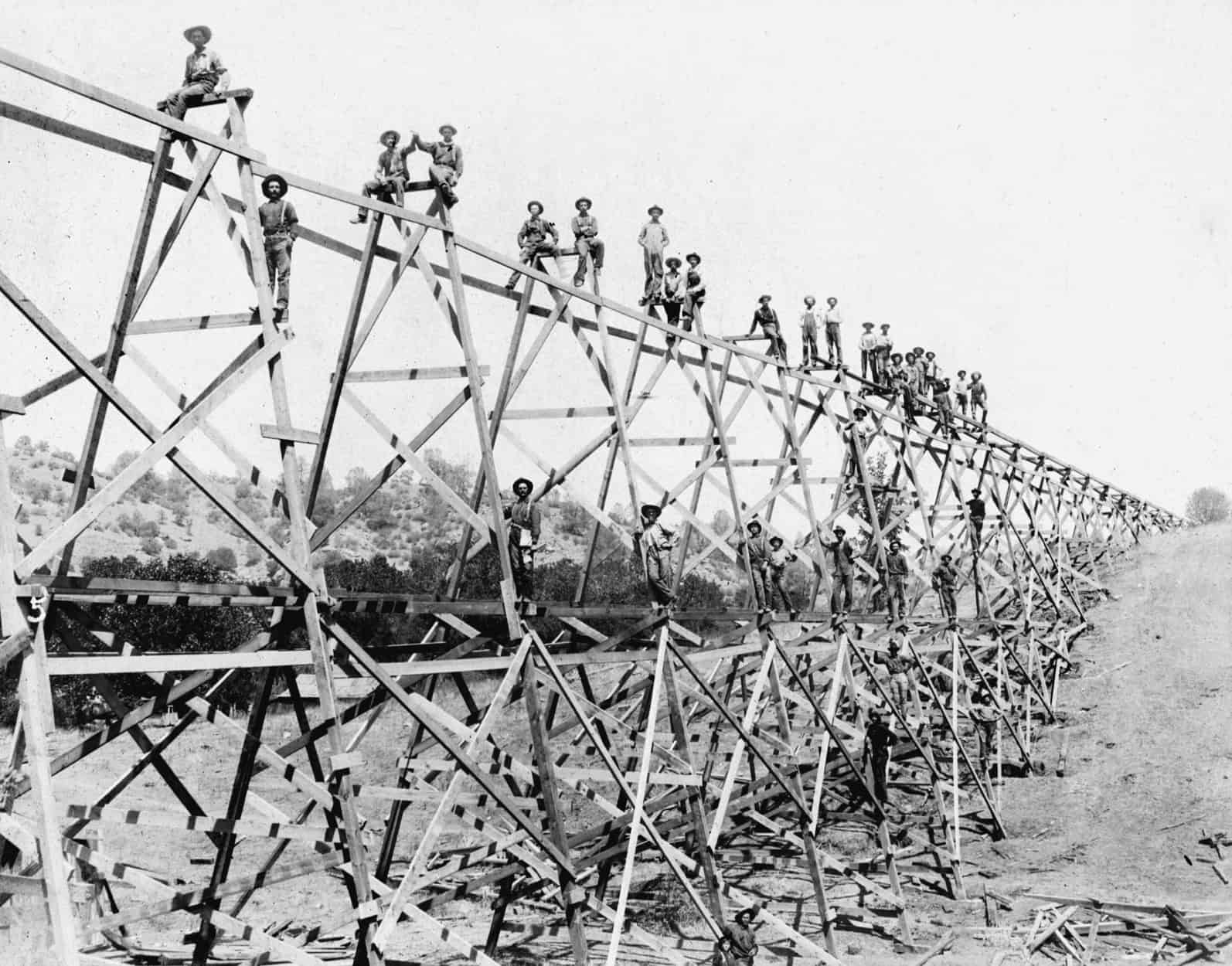
On Feb. 8, 1874, a company was formed precisely for that purpose. The newly constituted California Lumber Company announced it was building a mountain lumber mill near Fresno Flats and a V-flume to connect the mill with the railroad in the Valley.
This amazing project was carried out within two years. Retail yards and a box factory were erected at the flume’s Valley terminus on 40 acres of land donated by Isaac Friedlander, and the town of Madera was laid out. Within a year, however, the California Lumber Company was in deep trouble. The devastating drought of 1877 created a panic throughout the entire San Joaquin Valley.
Lumber piled up in the Madera yards awaiting customers who never came. On February 20, the short-lived operation was declared bankrupt, and its property passed to a San Jose Bank.
On May 21, 1878, the officers of the bank, led by a man with the unusual name of Return Roberts, incorporated another lumber company, the Madera Flume and Trading Comany. This successor to the California Lumber Company continued the Madera logging operation and helped save the town from an early death. Two sawmills were created in the mountains and soon lumber was once more making its way down the flume to the new little village of Madera. Adversity, however, remained poised and always threatened.
In 1881, a disastrous fire completely destroyed the lumber yards in Madera, and in the 1890s a nationwide depression put the Madera Flume and Trading Company on the verge of extinction.
At that point along came Elmer H. Cox, who with Roberts and Michigan lumber magnate Arthur Hill, formed a third major lumber company in Madera. Under Cox’s astute supervision, the Madera Sugar Pine Company was incorporated, and on May 8, 1899, it took over the assets of the Madera Flume and Trading Company.
The old lumber flume was rebuilt and extended. Logging techniques became more sophisticated as a logging railroad was pushed into the woods to enable loggers to cut timber some distance from the mill pond. By the 1920s, seven locomotives were needed to bring timber to the mill.
The Madera Sugar Pine Lumber Company existed for more than three decades and made money every season. It harvested more than 50 million board feet of timber annually and continued to pump life into Madera County’s mountains, foothills, and valley. Then in 1931 economic depression again raised its ugly head. Once more a nationwide depression destroyed the market for lumber, and the last log was finally cut.
Although the Madera yards continued to function for two more seasons, the mountain camp was closed for good. In due time, mill equipment and other properties were disposed of, and the corporation known as the Madera Sugar Pine Lumber Company quietly disappeared. Today, little remains of what once was the single most powerful economic force in Madera.
For more than 50 years the fortunes of Madera were inextricably bound to lumber; from 1876 to 1933 the town was nourished by lumber. To a large degree it was the resiliency of that industry that kept the town alive. By the time the death knell sounded for the limbermen, the farmers stood ready to fill the gap. Diversified agriculture took up where lumber left off.
Its eventual demise notwithstanding, the Madera Sugar Pine Lumber Company continues to be remembered. Its roll in Madera’s history is too important to be forgotten. The legacy of its lumberjacks will always enrich her history.