
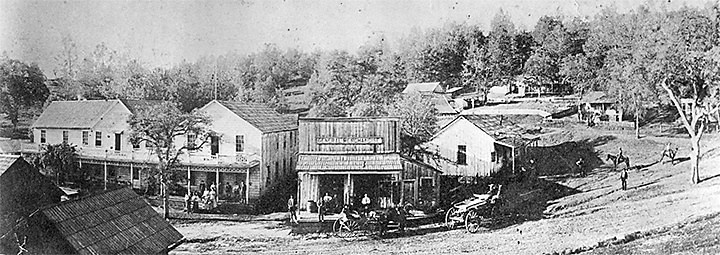
GOLD! That precious metal drew thousands of placer miners to what is now Madera County, and by 1851 they were calling their gathering Grub Gulch.
Through the years Grub Gulch emerged from its “tent city” status to take on all of the characteristics of a settled community. In time the town could boast of two hotels, a rooming house, five saloons, a grocery store and a general merchandise store. Located along a curve in the road between Raymond and Ahwahnee, Grub Gulch really began to prosper when in 1880 the nearby Gambetta mine began operations. Then in 1891 the Thomas Hotel was built, and a thin veneer of civilization settled over the town.
Under that covering, however, lay all of the emotions of the Old West. Men still carried pistols at the turn of the century, and most were quite willing to settle their disputes with guns even if it meant a public fight right on the porch of the Thomas Hotel.
It was Friday evening in Grub Gulch. The date was June 21, 1902. John Noble had just finished his shift at the Gambetta Mine and was walking through town about 6 p.m. As he neared the Thomas Hotel, he saw two men arguing on the porch. One was a large man over 6 feet tall and very muscular. The other by comparison was very small, about 5 feet 8 inches in height and weighing about 150 pounds.
It was clear to Noble that the larger man was the aggressor and that the smaller man was attempting to avoid a fight.
Just as Noble reached the hotel porch he was joined by Frank Diereck and Nelson Anderson. The three men could not believe what they were seeing. Charles Brim, the larger man, belted Jack Keith with a roundhouse punch that sent the smaller man reeling. Keith hit the front door of the hotel and dropped to the floor. From his knees he implored Brim, “I’ve had enough; I quit.”
When it became obvious that Brim had every intention of continuing his attack, Diereck stepped in to try to breck it up. At that point, Brim turned on the would-be peacemaker, threatening him with the same treatment that Keith was getting. Diereck backed away.
By that time, Keith had regained his footing and was inching toward the front door when Brim let him have it again. Once more the smaller man went down with a nasty gash above his left eye. This time he didn’t get up right away. He informed his assailant that he was armed and that he did not intend to take any more punishment. As he struggled to his feet for the second time, Keith pulled out a .32 caliber Smith and Wesson revolver. Brim, however, was not impressed at all.
“I don’t believe you have the nerve to pull the trigger,” taunted the larger man. With that, Brim hit Keith again, this time under the chin. He hit him so hard that he lifted him off the floor of the porch. As he went into the air, Keith fired his first shot. It found its mark, but it was only a flesh wound. When he hit the floor, Keith fired his second shot. This salvo also hit his attacker but failed to stop the beating.
Then Brim commenced to kick Keith while he was down, so the latter pumped two more shots into the aggressor at point blank range. This finally ended the fracas.
Brim grabbed his stomach, doubled up, turned facing the street and fell. Seeing his chance, Keith scrambled to his feet and ran into the hotel. Noble, Diereck, and Anderson rushed to Brim and turned him over. His most serious wound was the one in his side from which blood was flowing.
The wounded man was taken into the lobby of the Thomas Hotel, and within 30 minutes he was dead. The body was left on the premises until the authorities could be summoned. Keith, convinced that it was safe, came downstairs and went to Madera where he contacted attorney R.E. Rhodes.
Upon the advice of counsel, Keith went to the county jail where he awakened Sheriff J.F. Lewis.
By noon the next day Coroner Jay had journeyed to Grub Gulch to hold an inquest into the death of Charles Brim. The result of that deliberation was to completely exonerate Keith. If his action was not justifiable, nothing was.
What the two men were at odds over was never made public. Brim was buried, and Keith resumed his job as foreman of the Gambetta mine. Life in Grub Gulch went on as before but not for long. Four years later the mine closed.
Throughout its existence, Grub Gulch never did completely shed its frontier character, and that proved that the Old West was once very much alive in Madera County.