
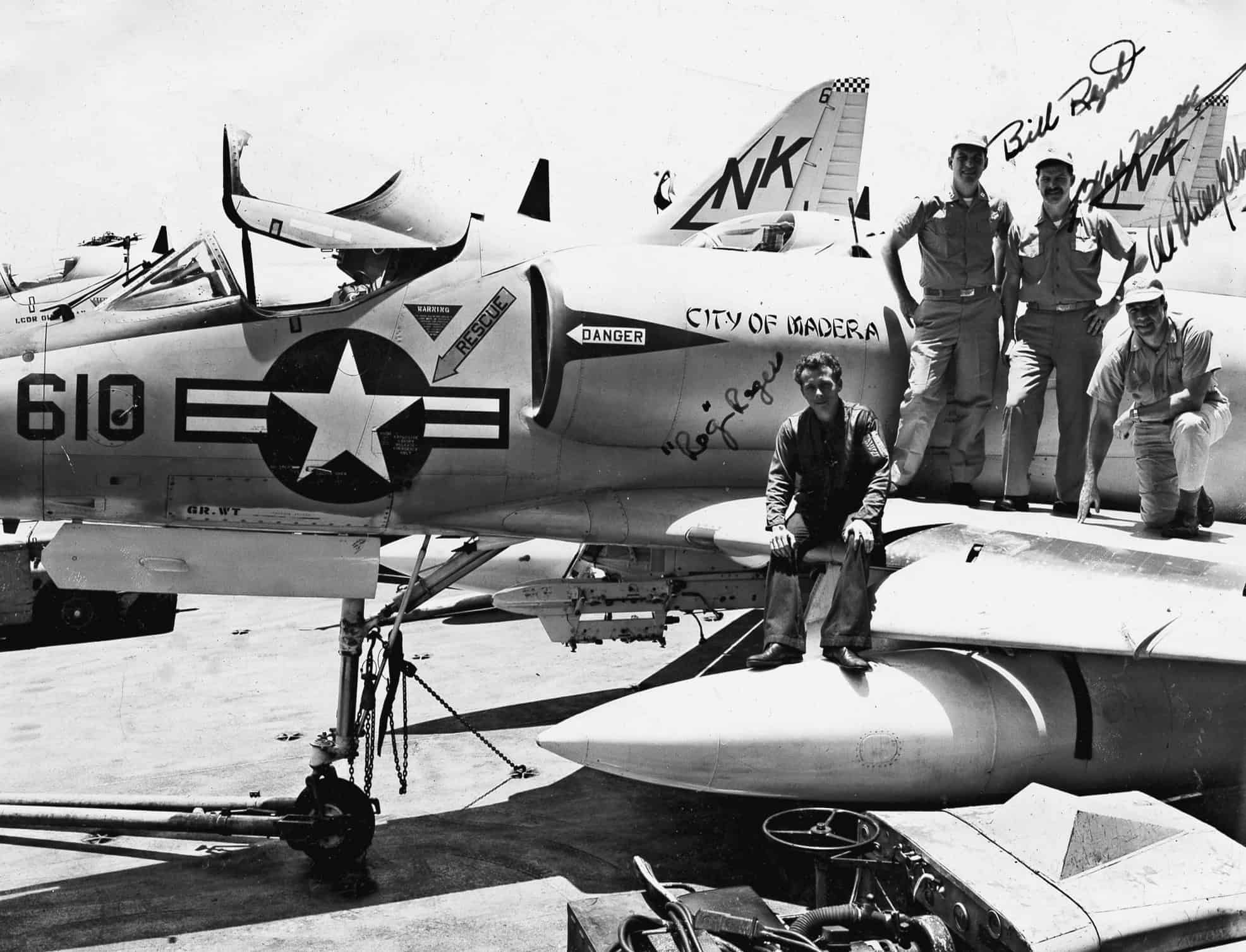
On April 6, 2004, I wrote about a couple of Navy pilots who flew combat missions over North Vietnam in an A4C Skyhawk that had been christened “City of Madera.” Their names were Lt. Hugh Magee and Lt. Bill Rezek. The men were from Lemoore Naval Air Station’s Attack Squadron 146, better known as the “Blue Diamonds.”
Imagine my surprise when I got an email from Magee, who retired from the Navy as a Commander and is now in his late 70s. He doesn’t know how it happened, but he accidentally logged onto an archive that carried my 2004 Pieces of the Past article, and when he saw the photograph that went with it, he said to himself, “Hey, that’s us!”
CDR. Magee called the Tribune and got my email address and sent the following message:
“Hello Mr. Coate,
“I am retired Navy Commander Hugh Magee, formerly of VA-146 at NAS Lemoore. I recently came across an article on the Internet, that you originally wrote on April 06, 2004, regarding the Squadron Skyhawk ‘Busy Bee 610’ which we called ‘City Of Madera.’ I was one of the two pilots assigned to “Madera” as described in your article.
“I remember that after we returned from the 1966 cruise, the Madera City Manager, Mr. Phil Brown & the City Council, honored our commanding officer, CDR Schaufelberger, Lt. Rezek and myself at a dinner at the Madera City Hall. We each described our operations (& adventures) in the “flak-filled” skies over North Vietnam.
“Sadly, Lt. Bill Rezek was stricken with a brain tumor and passed away some 20 years ago. CAPT. Schaufelberger remains in good health at age 87, in retirement in Hilton Head, SC, and I am retired in San Diego.
“Thanks for your fine article,
“Hugh ‘Slugger’ Magee
“CDR F. Hugh Magee, USN (Ret.)”
In that 2004 article, we told how Lt. Hugh Magee, fellow pilot, Lt. Bill Rezek, and aircraft mechanic, Airman “Rog” Rogers, were ordered to Southeast Asia in 1965.
Soon after receiving their combat orders, Magee and Rezek found themselves flying their A4C Skyhawk on missions over North Vietnam from the carrier, USS Ranger. In between flights Rogers armed the craft and kept it air-worthy.
In December 1965, Mcgee and Rezek decided to rechristen their plane. They chose the name, “City of Madera.” Madera’s response was immediate. City Administrator Phillip J. Brown, speaking for the council, informed the crew that Madera was eager to form the link.
Throughout 1966, officials of Madera received periodic reports on the activities of the “City of Madera.” A March 28 letter from squadron commander A.A. Schaufelberger, informed the council the plane had flown “an impressive number of missions, both in support of allied forces fighting the Viet Cong and against lines of communications and supply in North Vietnam.
Schaufelberger assured the council its “enthusiastic response and interest… buoyed the spirits of all the Blue Diamonds. “To know that friends and neighbors at home are behind us is a tremendous boost to our morale,’ continued Schaufelberger.
In April 1966, Magee, Rezek, and Rogers decided that it was time to treat the folks in Madera to a photograph of their “lady.” Like parents preparing a child for the camera, the threesome went to work on the City of Madera.” As is often the case with children in a photographer’s studio, the plane was not always cooperative. Magee wrote that it was difficult to “keep our ‘Madera’ on the deck…” He declared, “She is really a tiger.”
Interruptions notwithstanding, the job was finally completed. The “City of Madera” was washed, repainted, and made to sparkle. The picture was taken and within a few days the photograph was on its way to Madera.
With every preflight inspection, Magee and Rezek were reminded of their Valley connection and the fact that folks back home, in a sense, rode with them on every mission. Then in May, everyone’s worst fear was realized. The “City of Madera” was hit by anti-aircraft fire. Although the damage was extensive, Magee limped back to the carrier on a wing and a prayer. The shrapnel had pierced the port intake duct and went out through the starboard intake. Fortunately the engine was not damaged, and within three weeks the “Madera” was taking to the skies once more. The “City of Madera” was too tough to let a wound keep her out of action for long.
At the end of the summer of 1966, the crew of the “City of Madera” was told that new orders had been received. The airmen were going home. Memories of the San Joaquin Valley grew sweeter by the day in anticipation of the return.
“Though time and distance have kept us far removed, fond memories have been a constant reminder of how pleasant life can be in the Valley,” wrote Rezek.
The crew’s elation over the impending homecoming, however, was tempered by the knowledge that they would soon bid the “City of Madera” farewell.
By September 1966, it was time to say goodbye. As Magee, Rezek, and Rogers prepared to return to the Valley, the “City of Madera” was transferred to Atsugi Naval Air Base in Japan. For the crew, there was more than a twinge of regret at the parting with this collection of metal, nuts, and bolts, which had almost taken on a personality of its own.
“It goes without saying that we will miss her,” Rezek wrote in summing things up. “She is an outstanding lady. Now she is headed for a well-deserved rest.” Madera can be proud of its namesake and the history she wrote in the skies of North Vietnam.”
That, however was not the end of the story.
Between May 1966 and his homecoming at the end of that summer, Mcgee had one more adventure in the skies over Vietnam that almost cost him his life, but that will have to wait until later. It is too good to try to squeeze in here.