
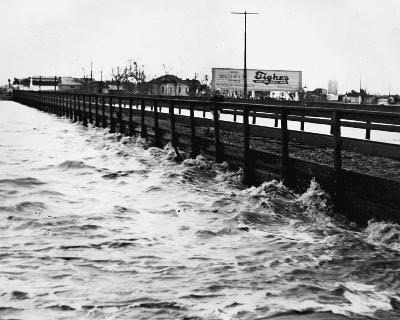
The teenager saddled his horse, mounted it, and prepared to make his usual trek to Arcola School. He didn’t live far away — just up Avenue 12 a ways — so it wasn’t as if he was crossing the plains. He enjoyed the ride, especially if the weather was good.
Sin embargo, esa mañana en particular, el clima definitivamente no era bueno. Llevaba varios días lloviendo a cántaros, y el agua se estaba acumulando en el lado este de las vías del ferrocarril Southern Pacific. Si lloviera mucho más, el agua rebasaría e inundaría las tierras de cultivo al oeste de la autopista Golden State, sin mencionar el patio de la escuela Arcola.
The young rider, however, was undaunted. Ray Pool was born with a streak of daring, and a little water wasn’t going to dampen his spirits. The natural optimism within him contrasted sharply with those pessimistic skies above him on that February morning in 1938.
The entire country had been reeling under severe weather for the past few weeks. High waters harassed the residents of Illinois, and northern Michigan while dust storms threatened winter wheat crops in Kansas. The source of all this misery was the Pacific storm system that rolled across California before crossing the Sierras and Rockies to pummel the Midwest, and as usual its presence was felt in the San Joaquin Valley before moving east.
The first regions of Madera County to bear the brunt of the storms of ’38 were the communities of Raymond and Coarsegold. On Thursday night, Feb. 4, the weather threw a severe electrical tantrum, and the area was plunged into darkness. Pellets of hail riddled the tops of cars with such force that at least one “resembled a much-used machine gun target.”
These, however, were just the harbingers of things to come. On the next day, new storm warnings were hoisted all along the Pacific Coast, and Madera began to batten down the hatches. Both the Sacramento and the San Joaquin Rivers were nearing their crests, and when the new storm hit, it staggered the Valley. In Merced, courthouse windows were smashed. In Modesto, roofs were blown off buildings, and in Fresno, a large meat-packing factory was destroyed.
For its part, Madera was “completely isolated from the outside world,” with the exception of the railroad telegraph lines, which were promptly appropriated by the Western Union. In the Storey district, Ted Betters’ 60 foot corrugated barn was blown away, leaving 75 tons of baled hay neatly stacked but without shelter. And still the rains came.
By Friday, February 11, those rains had been falling for 16 straight days, and Madera had received its fair share. On Thursday evening alone, 1.65 inches of rain fell locally. All of the county’s creeks and rivers were full an on the verge of running over. The Chowchilla River was about to leave its banks, while the Fresno River reached its highest point of the year within the city limits. Everybody was concerned, especially the folks around Cottonwood Creek.
Early Friday morning, the water reached the Southern Pacific tracks and quickly spread west across the Golden State Highway. The most serious break occurred in that area of Avenue 12. The land around Arcola School was completely flooded, and the student body had to be evacuated by emergency crews. The Arcola Home Baking Plant suffered damage to its machinery, as water entered the building. The passenger trains coming from the south were halted at Borden.
Meanwhile, at Dixieland School classes were called off at ten o’clock in the morning, as a solid sheet of water extended from the school house for a distance of four miles. Cattle had to be removed from corrals on the Poythress, Averill, Evans, Yenne, and Horder ranches, and at La Vina, dry clothing, bedding, and food were brought to flood victims there. Still the rains came. Madera was taking a real beating, just like the rest of the state.
As more and more water fell from the skies and ran out of the mountains, the choking streams coughed up their innards. A swollen Cottonwood Creek continued to pound the railroad from the east until finally it tore ninety feet of track from the railroad bed. At the northern end of the county, the Chowchilla River was equally destructive as it ripped up large portions of track.
In Madera proper, the fire department was kept busy pumping out the flooded basements in the Hughes Addition. On Clinton Street, in the front yard of Mrs. Julia Gordon, one of the city’s oldest landmarks fell victim to the storm.
The Giant Chinese Umbrella tree, planted there in 1877 by L.O. Sharp, was blown over in the night. All the while, the water in the farming regions continued to rise.
Then a strange thing happened. A major catastrophe was averted when the rains suddenly ceased, and the sun came out. Within 24 hours, the floodwaters began slowly to recede.
The rest of the state, however, continued to receive a pounding, as the downpour continued for three more days. Highways were closed all over California, and trains ran hours behind schedule because of washouts. Air flights were canceled, and casualties mounted. Damage, already in the millions, was climbing with each hour. All the while, in Madera there were, inexplicably, those blue skies and sunshine.
For young Ray Pool, the most pressing need was to see that his neighbors kept up with the news. He was determined that they were not going to be deprived of the Tribune just because the countryside was knee deep in water. Pool and his trusted steed were equal to the task during that memorable flood of 1938. While the county breathed a sign of relief, Ray delivered the paper on horseback.
It took a while for Madera County to return to normal. After all, a community doesn’t get rid of two feet of water over night.
Still, that sudden respite from the ravages of a very serious series of storms made Maderans grateful, especially those in the Cottonwood Creek area. Besides that, thanks to Ray Pool and his horse, they could read about their good fortune on the pages of their local newspaper.