
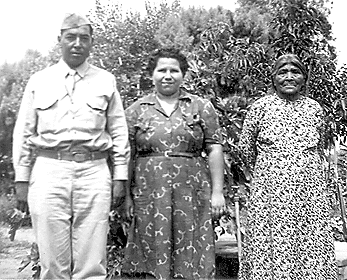
The ethnohistory of the North Fork Mono Indians, like all tribes of the area, is a story of trials, accomplishments, adjustments and integration. Throughout their history the tribe has learned to adapt to an ever-changing environment. Relationships with other tribes and settlers were crucial to survival.
We have learned much about the history of the Northfork Mono, as they became known, but there is still more to learn.
In the early part of the 20th century, records on the tribe were sketchy and a generally neglected topic. Indian advocacy groups pressured the Bureau of Indian Affairs (BIA) to re-examine their responsibilities toward California natives. The secretary for one of the advocacy groups, Charles E. Kelsey, was appointed to the bureau in 1904 to survey the conditions of California Indians, especially those who found themselves landless. His findings and recommendations were submitted to Congress in 1906 and ancestors of the Northfork Mono appeared on the census, constituting their first enumeration by the bureau as a distinctive group.
As a result of Kelsey’s work, the bureau purchased communal homes, rancherias, and individual tracts for allotments and homesteads. Eventually, the North Fork Rancheria was purchased near the Presbyterian Mission that many Northfork Mono children attended.
Most of the rancherias purchased for Indians were situated on poor quality land, not suitable for farming. The Northfork Mono generally used the land as a campground during their seasonal circuit and when visiting their children.
Historically, many Indian boarding schools around California were known as terrible places, but the Presbyterian Mission in North Fork does not appear to be an oppressive place. It wasn’t known as a place where native culture and language was suppressed. In fact, during the first decades of the 20th century, the mission was important to the survival of the Tribe. The mission provided food and shelter for their children, as well as stability and education in American ways, while parents worked the labor circuit.
The mission was also concerned with the health of the North Fork Mono. In 1923, Field Matron Blanche Landon reported that Indian children came back from the Valley, after working the vineyards at Minturn, with bad cases of impetigo. They asked the government to help provide health care. That care did not arrive until 1928.
The men and women of the North Fork Rancheria spent much of their time working the fields and ranches in and around the city of Madera. Some enlisted into the military, even though Indians were not considered citizens of the United States until 1924. Rancheria land could not support tribal citizens and many continued to intermarry, and migrate for employment purposes.
Then, in 1958, congress enacted the Rancheria Act, terminating federal trusteeship and recognition of 41 tribes in California, including the status and lands of the North Fork Rancheria of Mono Indians. In 1966, the North Fork Rancheria was terminated.
Even though federal recognition of the tribe had ended, the Tribe continued. Many relocated to the Valley’s urban area to access social and health services and find work.
In 1979, California Legal Services filed a class action suit against the federal government claiming the government failed to make clear provisions of the Rancheria Act and fell short of its promises for public improvements. The government settled the lawsuit in 1983 by restoring federal recognition to each of the 17 tribes represented in the suit, including the North Fork Mono.
• • •
In 2004, the North Fork Rancheria of Mono Indians began one of the most thorough and extensive ethnohistorical studies ever conducted by a California tribe. The study entailed significant financial investment and nearly two years of primary and secondary research on behalf of the Tribe.
More than 7,000 local, state and federal documents were analyzed and scores of personal interviews were held with tribal citizens and non-Natives. This ambitious research project was conducted by James M. McClurken & Associates, a preeminent authority in the field of ethnohistory who has conducted numerous studies for tribes throughout Canada and the United States.
The report, entitled “Ethnohistory of the Northfork Mono in the Vicinity of the City of Madera, California,” was written by Ms. Heather A. Howard, Ph.D., and made available by the Tribe in the Summer of 2006. The research project and final report represent the North Fork Rancheria’s commitment to better understand and relate Northfork Mono history, culture and values to its own citizens as well as others within the community.
This series of articles appeared in The Madera Tribune newspaper and website in August 2006 and distill the 400-plus page report into a single story of the Northfork Mono, from pre-contact to the modern era. The author, Mr. Cal Tatum, captures unique hallmarks and recurring themes in the history of the North Fork Rancheria, most notably the Tribe’s exceptional efforts to co-exist and adapt to the changing landscape — politically, culturally, and geographically — of Madera County. This adaptability continues to be a trademark of the Tribe’s relationship with the surrounding communities to this day. Like our historical connection to the lands of Madera County, it is an enduring part of our history.
We hope these articles will provide valuable insight into the Northfork Mono and other Native peoples of the San Joaquin Valley region. As always, our Tribe’s goal remains to be good friends, relatives, and neighbors to all who share this special place now called Madera.
— On behalf of our nearly 1,400 tribal citizens, we are sincerely, the Tribal Council of the North Fork Rancheria, September 2006