
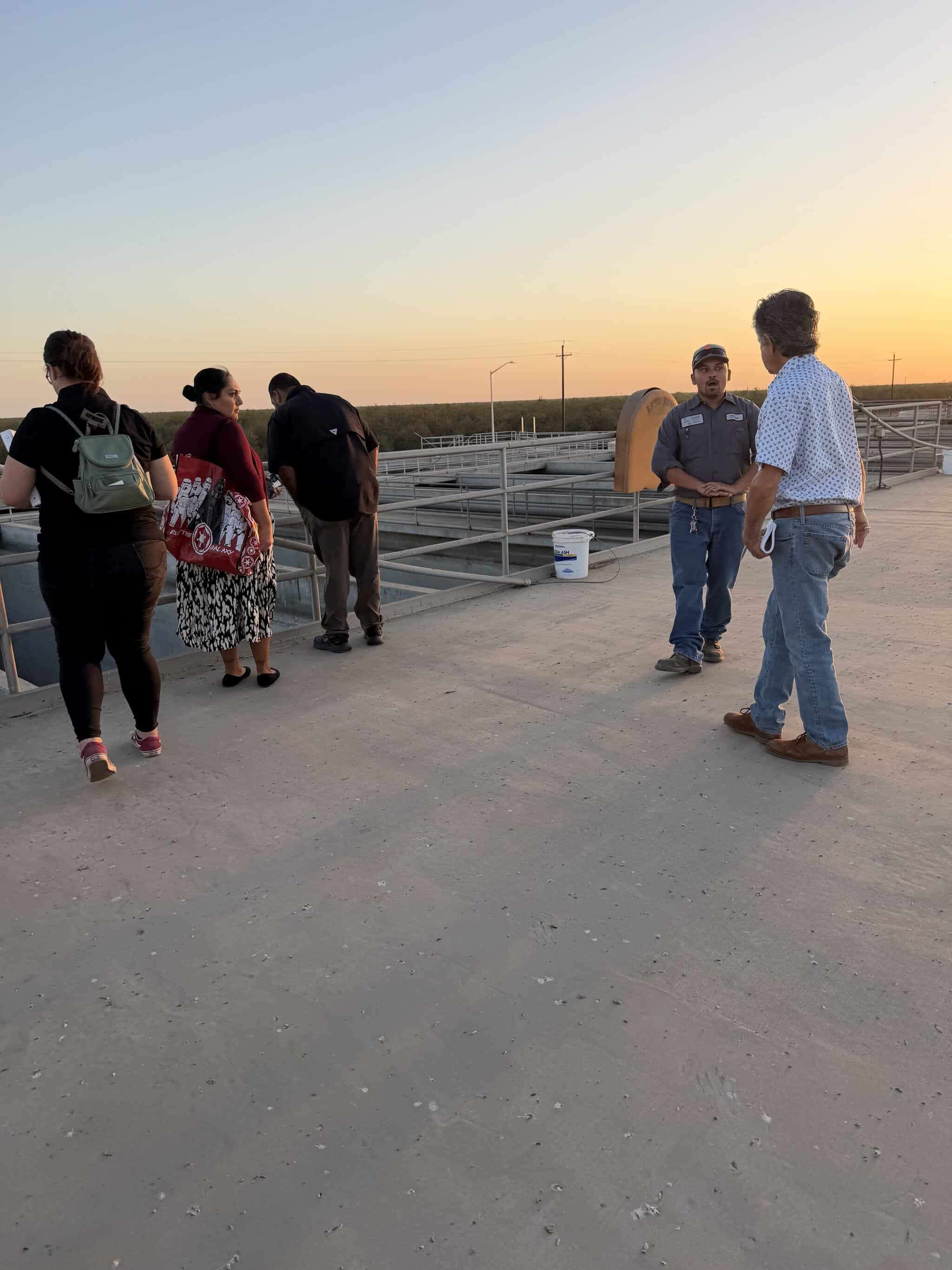
The City of Madera hosted its second Citizens Academy, a nine-session program intended to give residents an exclusive look at how local government operates through guided tours that showcase the different parts of Madera that help the city run but are often overlooked.
“Today you’re going to go to the Wastewater Treatment Plant,” Arnoldo Rodriguez, city manager, said. “It’s the city’s most expensive asset. It’s not very exciting, but it’s a critical piece of infrastructure.”
This week’s class was taken to see the Wastewater Treatment Plant, as well as the Cook Water Tower, which holds one million gallons of water.
“We did a big rehab on it [the water tower] for a little over three million dollars,” Rodriguez said. “That thing should be good for another forty years. That’s the city’s only water tower.”
During the class, Rodriguez mentioned the construction of a new water tower planned for the north side of Madera that is expected to cost a total of $30 million to construct. It will be located near Lake Street and Ellis Street.
The class then boarded city buses to head to the Wastewater Treatment Plant, where the tour was guided by Public Works Director Harpiar Gandhi and Deputy City Engineer for Capital Projects, Ellen Bitter, as Rodriguez and other city council members had to leave.
“Once you flush the water, it goes somewhere. With all the environmental regulation coming up, there’s no more, ‘it goes to the river, it goes to the trail, it goes to the field,’” Gandhi said. “There are now strict regulations, where cities are responsible for treating their waste.”
At the facility, Drew Martinez took the class through the plant to show what kind of work is done at the Wastewater Treatment Plant.
Wastewater treatment starts when dirty water, called influent, enters the treatment plant. The first step is removing larger materials that should not be in the system, such as trash, rags, and other materials known as grit. The water then moves to a primary clarifier, where heavier solids settle and more grit is removed.
Next, the water is treated with microorganisms, which are tiny living organisms that help clean the wastewater. The microorganisms then consume the organic material in the water, doing much of the heavy lifting needed to make the water cleaner. The plant provides the microorganisms with oxygen and food to keep them healthy and active.
“They’re eating, they’re having fun, and we want to keep them happy,” Martinez said. “That’s what we are, we’re bug farmers.”
After the microorganisms finish their work, the water moves into a secondary clarifier. Here, the microorganisms settle to the bottom while the clearer water floats to the top. That water is then collected and sent to ponds for additional treatment.
While the water is treated and becomes much clearer than when it starts, the water at the end of the treatment process is not drinking water. The water will receive another level of natural filtration as it moves through the soil in a process called percolation.
The treatment process also produces solid material called cake, which is removed from the wastewater and hauled away in trailers. The plant currently produces enough cake to fill about two trailers every couple of days.
“This is Class B biosolids. We turn it in and haul it off,” Martinez explained. “It gets turned into Class A biosolids, and they use it as fertilizer.”
The plant is also undergoing a $10- to $11 million construction project to install new bar screens. The screens will help remove more trash, rags and other materials during the treatment process.
After visiting the Wastewater Treatment Plant, the class was taken to see the Cook Water Tower. There, Gandhi and Bitter explained that the city’s water system relies on 18 wells to supply groundwater to the community.
Before the water is delivered to homes and businesses, it goes through a chlorination process for disinfection. The treated water is then stored and distributed throughout the city, with residential water pressure maintained between 45 and 50 PSI.
A majority of the city’s water supply comes from groundwater, which is naturally filtered as it moves through layers of soil and rock.
“We use 100 percent groundwater, so if you’re using surface water, you have to waste treat through a water treatment plan,” Bitter explained. “Our master plan has us relying on groundwater for the next 40 years, based on population.”