
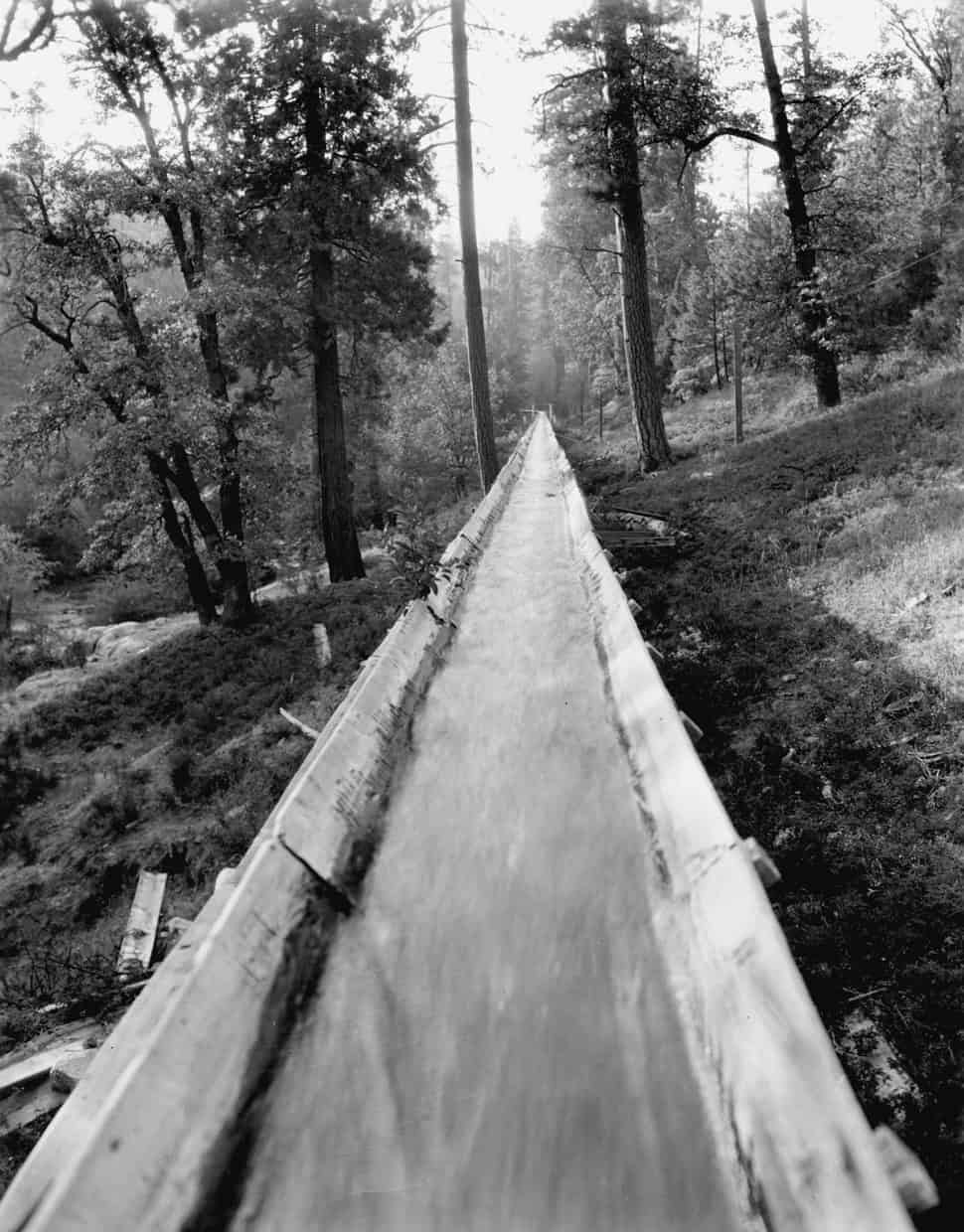
During the 33-year existence of the flume which gave birth to Madera, more than one billion feet of lumber floated down the big trough from the mountains toward the mill near where Millview School now stands.
Construida en 1876 por la California Lumber Company, el canal en V serpenteaba por las laderas de las montañas, atravesaba cañones escarpados y a menudo tenía que utilizar caballetes de más de 60 pies de altura.
Falling into disrepair, the flume was rebuilt in 1899, after being acquired by the Madera Sugar Pine Lumber Company. The new structure ran from Sugar Pine south to Fresno Flats (Oakhurst) and from there down to Madera, over a 54-mile route.
At 4 p.m. on a Saturday afternoon, October 27, 1900, the citizens of Madera celebrated the completion of the rebuilding project with a community barbecue.
During the workweek, the loading crews, which were primarily Chinese and Mexican, strapped the raw lumber into bundles at the mill in Sugar Pine, and a force of about 35 “flume herders” then shepherded the “flocks” of timber down the V-shaped trough.
Los pastores permanecieron en el canal de madera durante toda la temporada de tala. Vivían en pequeñas cabañas, que se llamaban casas del canal o estaciones. Su responsabilidad principal era evitar que la madera se atascara y vigilar si había fugas o roturas en el canal. Cada pastor tenía una sección del canal de la cual era responsable.
Había 10 casas de canaleta a lo largo de la ruta de 54 millas, y estaban separadas entre 2 millas y media y 7 millas. Algunas de las estaciones albergaban a un solo pastor, mientras que en otras, ocho o diez hombres pasaban la temporada.
Desde Sugar Pine, las estaciones del canal de madera estaban ubicadas en lugares tan exóticos como Salt Springs, Poison Switch, Confidence, Zuber, Ellerbrock, French Graveyard, Ralls, Chinese Store, 12 Mile house y Six Mile House.
La vida del cuidador de la compuerta era la mayor parte del tiempo simplemente solitaria, pero a veces había peligro.
Trying to walk on the slippery catwalk that ran along the flume was treacherous. Sometimes the herder found himself 60 feet or more above the ground, and it didn’t take much for a man to be dashed to pieces on the rocks below.
Several tenders lost their lives this way. A telephone line was strung along the length of the flume to keep the herders in communication with each other.
Al final de la temporada, que fue algún tiempo después del Día de Acción de Gracias, los canaleros cerraron el taller y empacaron sus maletas. Pusieron su equipo en un “bote de canal” y se dirigieron a Madera con el último carregamento de madera.
Las barcas del canal eran algo común en el canal de Sugar Pine. Además de los pastores, se sabía que las cuadrillas de reparación y los leñadores disfrutaban de un transporte rápido y económico hacia algún punto más abajo. En su mayor parte, estas excursiones se realizaban en las horas de la tarde, después de que toda la madera de ese día había sido transportada.
Un paseo por el canal sin duda competiría con lo mejor que el parque de diversiones moderno tiene para ofrecer. Para que el canal cumpliera su función, tenía que transportar agua de manera uniforme, y se determinó que la caída debía ser de una pulgada por cada 16 pies o 27 pies por milla.
En algunas de las pendientes, la velocidad alcanzaba las 50 millas por hora. A veces, la barcaza del canal artificial literalmente le ganaba la carrera al agua, en cuyo caso la embarcación golpeaba tablas secas, para ser poco después devorada por la fuerza del agua que venía tan cerca detrás.
Male workers were not the only ones to ride the flume. On one occasion the daughter of Return Roberts, one of the directors of the lumber company, took a 16-mile trip on the waters of the flume.
Bundles of lumber were sent on their daily journey down the flume, one after the other. The most dangerous part of the journey came on the way to Salt Springs, the first herder’s station on the route. The flume crossed “Chew Grade” here. This half-mile long descent was so named because it crossed the land of one Ah Chew, a Chinese tenant farmer. The flume ran across a deep ravine on a 65-foot high trestle.
At the Salt Springs, which was about 40 minutes from Sugar Pine, workers stopped the loads to check the clamps and then sent them on their way. This was repeated at all of the other stations until the lumber reached the valley floor.
Jam-ups were fairly common. Sometimes a nail would work up through the bottom of the trough. At other times the culprit might be a loose board or a weakened timber. All in all, however, the flume was a very efficient means of transporting lumber out of the mountains.