
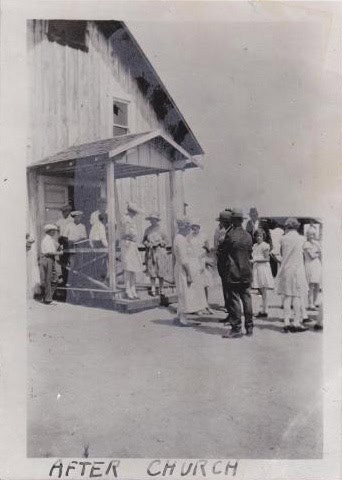
El Rev. William B. McElwee fue un trabajador incansable de la iglesia. Él y su esposa, Emily, llegaron a Madera en 1891 para pastorear la iglesia presbiteriana local. Había nacido en Missouri en 1838 y fue ordenado al ministerio cristiano a los 35 años. Aunque el Rev. McElwee tenía 53 años cuando asumió el pastorado presbiteriano en Madera, todavía tenía mucho fuego en su interior. No solo pastoreó la Iglesia Presbiteriana de Madera durante 14 años, sino que luchó la batalla de Madera por la moralidad en todos los frentes imaginables.
Predicó contra el alcohol, la prostitución, el juego e incluso el béisbol los domingos. Sin embargo, el colmo de las transgresiones de Madera fue la Gran Fiesta que llegó a Madera en septiembre de 1901. Luchó contra esa celebración comunitaria desde el púlpito con todo lo que tenía. El domingo anterior al día de la inauguración, subió a su púlpito con todo el fuego y azufre que pudo reunir. Sabía que habría juego, carreras de caballos, paseos en pony, música, bailes callejeros y mucho alcohol para sus feligreses. Pero lo peor de todo era la corrida de toros. Iba a haber una corrida de verdad, completa con matadores mexicanos aquí mismo en Madera. En su sermón del domingo antes de la fiesta, denunció sarcásticamente el evento propuesto.
“The fiesta, Yes, by all means, let us have it,” he thundered. “Never mind the fact that we have a large reserve of cynical skeptics, skillful in making religion ludicrous and odious; never mind that 20 dens of vice are running day and night and seven days in the week; never mind that a prize ring catering to the lower tastes of humanity has been constructed; never mind that Sunday is a synonym for baseball games, bicycling and horse racing.
“Suicides are frequent and on the increase; we have a criminal docket beyond anything we have had before; the trend of the young and old are all along the same decline. However, we must be on the lookout. It is still possible that some child may grow up innocent, or some virtuous youth may be overlooked.
“Nothing is good except it be the best; to falter is hazardous, and to economize is criminal when character is involved. In a word, our homes are not equal to the present demand. Our motto must be: ‘Let no innocent child or virtuous youth escape.’ Let the ‘prominent’ citizens invoke the aid of the Chamber of Commerce. Let every individual be laid under contribution, from the Superior Judge on the bench to the Gospel minister in the pulpit. Let the whole community be aroused and not only $2500 of stock be taken, but $50,000 be subscribed to turn the sewage of Mexico into the San Joaquin valley for a fiesta.
“Make Madera during the week beginning September 9th a cesspool of filth in which slimy reptiles may thrive, and from which moral malaria may exhale more deadly than the atmosphere of the Grotto Del Cano, and when this fiesta is over and the county enriched by its deposit, herald it abroad to the tenderfeet of every state; bring in your sons and daughters and share with us the elixir which has given to Spain today the place she occupies in the constellation of nations.
“Y si alguien te pregunta quién es el que prodiga tantos consejos, dile: Es uno que teme más a Dios que a los hombres y ama a la gente de Madera más de lo que ama su beneplácito, y su nombre, con el que su padre lo nombró, es William Black McElwee.”
Bueno, Madera tuvo su fiesta, un éxito rotundo para cualquier medida, y McElwee continuó exponiendo audazmente desde el púlpito por cuatro años más, luego se llevó una sorpresa.
El lunes 10 de abril de 1905, los ancianos de la Iglesia Presbiteriana celebraron una reunión para votar sobre su pastor. Se hizo una moción para contratar los servicios del Rev. McElwee por un año más. Hubo tres votos a favor de la moción y tres en contra. Todas las miradas se volvieron hacia McElwee; su voto rompería el empate, pero para sorpresa de todos, se negó a votar. Con el voto empatado, la moción fracasó y el Rev. McElwee se quedó sin trabajo.
On June 3, 1905, Rev. McElwee gave his final sermon in Madera. The church was filled, and the newspaper took note. Madera’s pioneer preacher apparently had worked himself out of a job in his contest with evil. The Mercury reporter said he “seemed affected, and at times his voice quivered. He stated that he regretted his departure.”
El Rev. McElwee se mudó a Fresno para pastorear una iglesia allí, pero nunca olvidó Madera. El 1 de marzo de 1918, se le pidió que predicara el funeral de William Kerr, que tuvo lugar en la Iglesia Presbiteriana que había pastoreado durante tanto tiempo. Sería su último viaje a Madera para predicar. Antes de que terminara el año, él murió.
El 19 de noviembre de 1918, a la edad de 80 años, el viejo guerrero depuso su arma y se fue a casa. Había sido un “buen y fiel servidor” y merece un lugar en el salón de la fama de los pioneros de Madera.